Somatik Spiralizm
manifesto
Somatic Spiralism
manifest
1. Tanım ve Konumlandırma
Somatik Spiralizm, çağdaş görsel sanatlar alanında beden merkezli bir biçim üretim ekolü olarak konumlanan, spirali ontolojik, epistemolojik ve morfolojik bir ilke olarak ele alan özgün bir sanat yaklaşımıdır.
Bu ekol, spirali tarihsel bir süsleme motifi ya da biçimsel tekrar olarak değil; bedensel devinimin, solunum ritminin, zamansal sürekliliğin ve duygulanımsal yoğunluğun yapısal ifadesi olarak tanımlar.
2. Temel Varsayım
Somatik Spiralizm’in temel varsayımı şudur:
Her görsel form, bedenden geçen kinestetik bir süreklilik taşır.
Spiral, bu sürekliliğin hem yapısal hem de algısal biçimidir.
Bu bağlamda spiral:
-
bedensel hareketin mekânsal izidir,
-
solunumsal döngünün morfolojik karşılığıdır,
-
zaman ile beden arasındaki ilişkinin geometrik ifadesidir.
3. Ontolojik İlke: Spiral Varlık Anlayışı
Somatik Spiralizm, varlığı doğrusal bir ilerleme olarak değil; kendi içine kıvrılan, yoğunlaşan ve yeniden açılan döngüsel bir süreklilik olarak ele alır.
Spiral, bu yaklaşımda:
-
yalnızca bir form değil,
-
varoluşun örgütlenme ilkesidir.
Bu ontoloji, resimsel formu tamamlanmış bir temsil nesnesi olmaktan çıkarır; bedensel devinimin zamansal bir yoğunlaşması olarak konumlandırır.
4. Epistemolojik İlke: Somatik Bilgi
Somatik Spiralizm, Kartezyen zihin-merkezli bilgi anlayışına karşı konumlanır.
Bu ekole göre:
-
beden, yalnızca algılayan bir yüzey değildir;
-
beden, bilgiyi üreten, kaydeden ve dönüştüren bir epistemik alandır.
Resimsel bilgi:
-
önceden belirlenmiş kavramsal şemalardan değil,
-
bedensel ritimlerin zamana yayılan yoğunluklarından türetilir.
Bu nedenle Somatik Spiralizm’de bilgi, temsil yoluyla değil; somatik devinimin sürekliliği aracılığıyla ortaya çıkar.
5. Biçimsel İlke: Somatik Jest
Somatik Spiralizm’in biçimsel üretim modeli, somatik jest kavramına dayanır.
Somatik jest:
-
Biçimsel süreci başlatan bedensel itkidir,
-
Zamansal akışı mekânsal sürekliliğe dönüştürür,
-
Spiral morfolojinin mikro-dinamiklerini kurar.
Bu bağlamda jest:
-
ifade eden bir işaret değil,
-
formun ortaya çıkış koşuludur.
Resim, özne merkezli bir anlatım alanı olmaktan çıkarak, bedensel süreçler merkezli bir yapıya dönüşür.
6. Resimsel Yapının İlkeleri
Somatik Spiralizm, resim pratiğini üç temel ilke üzerinden tanımlar:
6.1. Somatik İz
Tuvaldeki her çizgi, bedenin hareket hafızasını taşır. Bu iz rastlantısal değil; bedenin spiral yönelimlerinin grafik izdüşümüdür.
6.2. Çok Katmanlı Spiral Zaman
Eserler tekil bir anı temsil etmez; farklı zaman katmanlarının spiral biçimde üst üste binmesiyle oluşur. Okuma doğrusal değil, döngüseldir.
6.3. Spiral Akış Dinamiği
Kompozisyon geometrik merkezlere değil; enerjetik odaklara dayanır. Merkez ile çevre arasında sürekli bir genişleme–yoğunlaşma ilişkisi kurulur.
7. Bedenin Konumu
Somatik Spiralizm’de beden:
-
temsil edilen bir nesne değil,
-
resimsel formu doğrudan kuran ontolojik bir alandır.
Figür, anlatı taşımaz; devinim üretir.
Biçim, anlamdan önce gelir.
Kadın bedeni, bu ekolde tematik bir kategori olarak değil; yaşam, yas, doğum, direnç ve süreklilik döngülerinin bedensel merkezi olarak konumlanır.
8. İzleyici ve Algı
Somatik Spiralizm’de izleyici pasif değildir.
Bakış, resimsel sürece eklemlenir ve spiral akışı genişletir.
Her izleyici, kendi bedensel hafızası aracılığıyla eseri yeniden kurar.
Bu nedenle yapıt:
-
kapalı bir nesne değil,
her algıda yeniden açılan bir süreçtir.
9. Estetik Tutum
Somatik Spiralizm’in amacı spiral biçimler üretmek değil;
-
bedensel ritmi görünür kılmak,
-
devinimi resmin ontolojik temeli hâline getirmek,
-
spirali estetik bir motif olarak değil, varoluşun sezgisel bir açıklaması olarak sunmaktır.
Bu yaklaşım, çağdaş figüratif ve soyut gelenekler arasındaki ikili karşıtlığı aşan bir estetik zemin önerir.
10. Sonuç ve Kurucu İlke
Somatik Spiralizm:
-
bir resim ekolü,
-
bir beden ontolojisi,
-
bir somatik epistemoloji,
-
bir estetik sistemdir.
Ekolün kurucu ilkesi şu ifadede özetlenir:
“Varlık döner; dönüş bedenleşir; beden resme dönüşür.”
Bu manifesto, Somatik Spiralizm’in tarihsel başlangıcı, kuramsal çerçevesi ve metodolojik temelleri adına resmî referans metni olarak kabul edilmelidir.
SOMATİK SPİRALİZM ESER ANALİZLERİ

Figure 1. Nil Büyükbayraktar (birnil), Dance (2020), 120 × 100 cm, tuval üzerine yağlıboya. Kompozisyon, bedenin çoğullanmış, kıvrımlı ve spiral-aksiyomatik bir kurguda çözüldüğü, jest ve duygu alanlarının eşzamanlı açıldığı somatik-figüratif bir yapı sunar.
1. TEKNİK ANALİZ
Eserde figürler çoğul yüzler, üst üste bindirilmiş kollar, akışkan tors yapıları ve ritmik pembe-boz tonlar aracılığıyla deforme edilerek sunulur. Nil Büyükbayraktar’ın karakteristik tekniği olan yumuşak geçişli modelleme, pürüzsüz yüzey, spiralize plastik yapı ve heykelsi hacimlendirme göze çarpar.
Arka planın düz ve mat sıcak sarı tonla tutulması, figürün hem ikonik hem de sahneleşmiş bir alan içerisinde titreşim kazanmasını sağlar.
Fırça darbeleri görünmezleşecek ölçüde rafine edilmiştir; bu yaklaşım, figürün materyal gerçekliğini geri çekip, ontolojik-spiral dönüşümü öne çıkarır. Bu durum, Merleau-Ponty’nin “beden her zaman görülen ile hissedilen arasında yaşayan bir arayüzdür” önermesiyle uyumludur (Merleau-Ponty, 1962).
2. SOMATİK ANALİZ
Eserdeki beden, anatomik doğruluğa değil, bedenin his-anılarını taşıyan bir somatik ize dayanır. Kolların ve yüzlerin çoğalması, tekil bir benlikten çok, bedensel deneyimin çoğul bilinç durumlarını temsil eder.
Eller yüzün etrafında sürekli yer değiştirerek korunma–açığa çıkma arasında devinen bir duygu sahnesi oluşturur.
Gövdedeki boşluk, iç oyuk ve kıvrımlar içsel duyumsama alanının dışavurumuna işaret eder.
Başların ikiye ayrılması, somatik hafızada çift yönlü zaman deneyiminin—hem olan hem olanaklı olanın—eşzamanlı varlığını gösterir (Sheets-Johnstone, 2011).
Bu yapı, bedeni edilgen bir nesne olmaktan çıkarıp akışkan bir öznel-mekân hâline getirir.
3. TOPOLOJİK ANALİZ
Nil Büyükbayraktar’ın figürleri genellikle topolojik deformasyon prensibine bağlı çalışır: beden parçaları klasik hacimsel anatomiden ziyade bükülmüş yüzeyler, katlanan vektörler, spiral kıvrımlar ve çoklu yüzey süreklilikleri üzerinden inşa edilir.
Bu eserde:
Figürün kol ve gövde hatları Moebius-vari bir geçişliliğe sahiptir; iç-dış, ön-arka ilişkileri sürekli yer değiştirir.
Yüzlerin üst üste binmesi çok katmanlı topolojik zaman yaratır; figür, tek bir anın değil, süreklilik gösteren bir hareket alanının temsilidir.
Göğüs, omuz ve yüz hatları arasında kesintisiz bir akış kuran bükümlü düzlemler, görünen form kadar formun kaçış çizgisini de görünür kılar (Deleuze & Guattari, 1987).
Bu topolojik yaklaşım, figürü “tek bir beden değil, değişen bir yüzey” hâline getirir.
4. SOMATİK SPİRALİZM BAĞLAMINDA KURAMSAL ÇÖZÜMLEME
Somatik Spiralizm’in temel kavramları—spiral ontoloji, beden temelli epistemoloji, somatik iz, çok-katmanlı spiral zaman, spiral akış dinamiği—bu eserde belirgin biçimde görünür.
a. Spiral Ontoloji
Figürün her parçası diğerine kıvrılarak bağlanır; kol, yüz, gövde ve jestler arasında kesintisiz spiral geçişler vardır. Bu, “varlık döner; dönüş bedenleşir” ifadesinin doğrudan görsel karşılığıdır.
b. Beden Temelli Epistemoloji
Bilgi, figürün parçalanmış görüntüsünde değil, onun dönüş hareketinde ortaya çıkar. Beden, spiral akış içindeki bilgisel birim hâline gelir. Yüzlerin çoğalması, bilmenin duyu-alanları arasında dolaşımını işaret eder.
c. Somatik İz
Beden, yaşanmışlığın anatomik değil enerjetik bir kaydı gibi okunur. Gövde içindeki boşluk—tam da Somatik Spiralizm’deki “içten dışa doğru devinen iz”—bedenin geçici özdeşliğini açığa çıkarır.
d. Spiral Zaman
Bir yandan kolların havada “donmuş” hareketi vardır; öte yandan yüzlerin farklı yönlere bakışı aynı anda birden çok zaman düzlemini çağırır. Bu yapı, spiral zamanın katmanlı ve eşzamanlı işleyişini görselleştirir (Massumi, 2002).
e. Spiral Akış Dinamiği
Tüm kompozisyon bir dans figürünün içinde kıvrılarak kendi alanını yaratır. Bu dinamizm, Somatik Spiralizm’in “bedenin dönüşü resme dönüşür” önermesini tam olarak gerçekleştirir.
KAYNAKÇA
Deleuze, G., & Guattari, F. (1987). A thousand plateaus: Capitalism and schizophrenia. University of Minnesota Press.
Massumi, B. (2002). Parables for the virtual: Movement, affect, sensation. Duke University Press.
Merleau-Ponty, M. (1962). Phenomenology of perception. Routledge & Kegan Paul.
Sheets-Johnstone, M. (2011). The primacy of movement (2nd ed.). John Benjamins.

Figure 2. Nil Büyükbayraktar (birnil), 3. 2021 Kompozisyon, 100 × 80 cm, tuval üzerine yağlıboya. Eser, birden çoğalan figürler, iç içe kıvrılan beden yüzeyleri ve yoğun kırmızı zemin üzerinde spiralize somatik bir dramaturji kurar.
1. TEKNİK ANALİZ
Kompozisyon, Büyükbayraktar’ın özgün plastik dilinin belirgin özelliklerini taşır: akışkan anatomik deformasyon, çok odaklı yüz yerleşimi, bükümlü hacim kurgusu, yumuşak geçişli modelleme ve renk alanlarının dramatik karşıtlığı.
Arka planın yoğun, doygun kırmızısı; figürlerin ten tonlarıyla güçlü bir gerilim oluşturur. Kırmızı, hem sahne etkisi yaratır hem de figürler arasındaki içsel bağın dramatik atmosferini güçlendirir.
Ten yüzeyleri satenimsi, katmanlı bir ışık geçişi içerir; bu sayede beden, klasik figüratif resimdeki hacimsel tanımdan ziyade kinetik bir yüzey gibi işler. Kollar ve yüzler arasındaki yumuşak kesintiler, resme heykelsi bir bütünlük verir; adeta tek bir bloktan açılan spiral katmanlar izlenimi ortaya çıkarır.
Bu plastik yaklaşım, “görmenin, dokunsal olanla kurduğu sürekli alışveriş” fikriyle uyumludur (Merleau-Ponty, 1962).
2. SOMATİK ANALİZ
Eserdeki figürler tekil bir bedene ait oldukları hâlde çoğul zihin, çoğul duygu ve çoğul kimlik hâllerini içerir. Bu durum, Somatik Spiralizm’in “bedenin sabit bir varlık değil, sürekli dönen bir deneyim alanı” olduğu önermesiyle doğrudan ilişkilidir.
Yüzlerin birbirine yakın, içe kapanık ama aynı zamanda birbirini duyan yerleşimi bağlılık – korunma – yakınlık hissi yaratır.
Kolların döngüsel, neredeyse bir sarma hareketine benzeyen konumlanışı, figürlerin hem birbirine hem kendi içsel alanına “yuvalanma”sını temsil eder.
Ellerin narin ama keskin pozisyonları duygulanımsal titreşimleri görünür kılar.
Alt figürün yukarı doğru bakan yüzü, somatik hafızanın içsel bir çağrışım anını temsil eder (Sheets-Johnstone, 2011).
Burada beden, tek bir formdan çok, duyumsayan bir psikolojik topografya olarak çalışır.
3. TOPOLOJİK ANALİZ
Kompozisyon, topolojik dönüşüm kavramlarıyla okunmaya son derece elverişlidir:
a. Süreklilik
Beden yüzeyleri iç içe kıvrılarak düğümlenmeyen bir süreklilik oluşturur; bu, Deleuze’ün “bedenin katlanan mekânı” dediği dönüşüme işaret eder (Deleuze, 1988).
b. İç-Dış Reversibilitesi
Sarmal kollar, figürün iç alanını hem koruyan hem de dışa açan geçirgen bir zar hâline getirir; iç–dış arasındaki sınır topolojik olarak kayganlaşır.
c. Çoklu Yüzeyler
Büyükbayraktar’ın karakteristik yüz çoğalmaları, topolojik olarak farklı “görüş noktaları”nın aynı yüzeye katlanması gibi çalışır. Yüzler aynı bedende farklı zaman-dilimi işlevi görür.
d. Spiral Formasyon
Kolların ve omuzların kıvrımı belirgin bir spiral döngü oluşturur; bedenin geometrisi dairesel değil, spiral bir yönlülük taşır.
Bu form, sabit bir hacmi değil, devinen bir akış yüzeyi üretir.
4. SOMATİK SPİRALİZM BAĞLAMINDA KURAMSAL ÇÖZÜMLEME
Eser, Somatik Spiralizm’in tüm ana kavramlarının doğrudan görsel karşılığını içerir.
a. Spiral Ontoloji
Figürler, bir “oluş hâli” olarak devam eder; dönüşen, genişleyen ve birbirine dolanan yüzeyler, varlığın spiral yapısını açığa çıkarır. Spiral, burada hem ontolojik (varlık) hem de ilişkisel (birbirine yönelen bedenler) bir aksiyom olarak çalışır.
b. Beden Temelli Epistemoloji
Beden, bilgiyi taşıyan bir nesne değil, bilgiyi ürettiği bir süreçtir. Birbirine dolanan figürler, bilmenin bedensel hareket ve yakınlık yoluyla gerçekleştiğini önerir (Massumi, 2002).
c. Somatik İz
Beden gerilimi, sarılma jesti, yüzlerin yakın teması; hepsi bedensel deneyimin duyumsal izlerini açığa çıkarır. Bu iz, anatomik değil kinestetik bir hafıza biçimidir (Sheets-Johnstone, 2011).
d. Spiral Zaman
Yüzlerin üçlü çoğalması, tek bir anı değil; geçmiş, şimdi ve mümkün olanın aynı anda var olduğu bir spiral zaman deneyimi üretir.
e. Spiral Akış Dinamiği
Kompozisyonun tümü, tek bir ana hareketin (sarma/hug/dairesel birleşme) spiral varyasyonlarıyla kuruludur. Bedenler aynı hareketi birbirine devreder; bu devinim resmin içsel ritmini oluşturur.
Bu nedenle eser, Somatik Spiralizm’in sloganı olan “Varlık döner; dönüş bedenleşir; beden resme dönüşür.” önermesini eksiksiz biçimde temsil eder.
KAYNAKÇA
Deleuze, G. (1988). Foucault. University of Minnesota Press.
Massumi, B. (2002). Parables for the virtual: Movement, affect, sensation. Duke University Press.
Merleau-Ponty, M. (1962). Phenomenology of perception. Routledge & Kegan Paul.
Sheets-Johnstone, M. (2011). The primacy of movement (2nd ed.). John Benjamins.

Figure 3. Nil Büyükbayraktar (birnil), One Body, Three People (2021), 100 × 100 cm, tuval üzerine yağlıboya. Tek bir bedenin üç yüz ve üç jest halinde çoğaldığı kompozisyon, spiral akış, topolojik bükülme ve somatik birlik temalarını bir arada işler.
1. TEKNİK ANALİZ
Eser, Büyükbayraktar’ın karakteristik plastik dilinin tanımlayıcı öğelerini taşır: akışkan anatomik kırılmalar, yumuşak ton geçişleri, birbirine eklemlenen hacimler, kırışık drape etkili kol formları ve çoğul yüz ifadeleri.
Zemin, nötr bir gri-yeşil alan olarak figürleri dramatik biçimde öne çıkarır.
Beden yüzeyleri, pembe-nude tonların katmanlı geçişleriyle heykelsi bir bütünlük kazanır.
Kolların tüp formunda kıvrılması, karakteristik “spiral bükülme” etkisi yaratır.
Yüzlerdeki hafif melankolik ifadeler, “içsel gerilim – duygusal açıklık” ikiliğini taşır.
Bu modelleme biçimi, dokunsal görme kavramını çağrıştırır; beden yüzeyleri adeta parmak ucu duyarlılığıyla işlenmiştir (Merleau-Ponty, 1962).
2. SOMATİK ANALİZ
Figürler tek bir beden olarak başlar, ardından üç farklı duygu hâli ve üç farklı yönelme olarak çoğalır. Bu üçlü çoğalış, somatik bölünme değil, somatik genişleme olarak işler.
Ortadaki figür jesti, içsel bir duyumsama alanını işaret eder.
Soldaki figürün başının hafifçe yana eğilmesi, temas ve duyarlılık hissi uyandırır.
Sağdaki figür, ileri doğru uzayan boynu ve hafif geri duruşuyla “mesafe – gözlem” ikiliğini taşır.
Bu üç hâl, aynı bedenin üç duygulanım katmanı olarak okunabilir. Beden, burada bir “psişik harita” işlevi görür (Sheets-Johnstone, 2011).
Ellerin narin, lineer çizgisel yapısı bedenin duygulanımsal titreşimini somutlaştırır.
3. TOPOLOJİK ANALİZ
Eser açık biçimde topolojik dönüşüm ve süreklilik ilkeleriyle çalışır.
a. Bir Beden – Çoklu Yüzey
Tek bir gövde yüzeyi, üç ayrı “uç” üzerinden dallanır; böylece beden bölünmez, çeşitlenir.
b. Katlama (Folding)
Kollar, Deleuze’ün “fold” (kat) kavramını anımsatan biçimde kıvrılarak iç-dış ilişkisini geçirgen hâle getirir (Deleuze, 1988).
c. İç–Dış Sürekliliği
Dışarı açılan kollar, içe dönen gövde kıvrımlarıyla sürekli bir akış alanı yaratır; sınırlar erir, yüzey süreklileşir.
d. Spiral Topoloji
Boyunların ve kolların kıvrımı bir dönme hareketi oluşturur; bu hareket, figürlerin konumunu belirleyen temel geometrik dinamik olarak çalışır.
Böylece kompozisyon, sabit hacim yerine dönüşen bir mekânsal örgütlenme sunar.
4. SOMATİK SPİRALİZM BAĞLAMINDA KURAMSAL ÇÖZÜMLEME
Bu eser, Somatik Spiralizm’in temel varsayımlarını doğrudan somutlaştırır:
a. Spiral Ontoloji: Varlığın Kesintisiz Dönüşü
Beden tek bir varlık olarak başlar fakat spiral dönüşle üç ayrı figüre açılır. Bu açılım, Somatik Spiralizm’in “Varlık döner; dönüş bedenleşir” ilkesinin görsel karşılığıdır.
b. Çok-Katmanlı Spiral Zaman
Üç yüz, aynı bedende üç ayrı zamansal kip üretir:
-
geçmişten gelen hafıza (soldaki yüz),
-
şimdi’nin duyumsal açıklığı (ortadaki yüz),
-
geleceğe yönelen algı (sağdaki yüz).
Zaman böylece doğrusal değil, spiral bir akış biçiminde örgütlenir.
c. Beden Temelli Epistemoloji
Beden, üç farklı bilişsel ve duygusal hâli aynı anda taşıyan bir bilgi alanı olarak işlev görür. Bu epistemoloji, bilmenin düşünceden önce bedensel bir süreç olduğunu vurgular (Massumi, 2002).
d. Somatik İz: Duygulanımın Bedende Katmanlanması
Her yüz ve jest, duyumsal bir iz taşır; beden üzerindeki bu izler, figürün somatik hafızasını görünür kılar (Sheets-Johnstone, 2011).
e. Spiral Akış Dinamiği
Kompozisyonun bütününü çevreleyen ana akış, boyun-kol-beden üçgeninde dairesel değil, spiral yönelimli bir devinim yaratır. Böylece beden yalnızca temsil edilmez; dönüşün kendisi olarak çalışır.
KAYNAKÇA
Deleuze, G. (1988). Foucault. University of Minnesota Press.
Massumi, B. (2002). Parables for the virtual: Movement, affect, sensation. Duke University Press.
Merleau-Ponty, M. (1962). Phenomenology of perception. Routledge & Kegan Paul.
Sheets-Johnstone, M. (2011). The primacy of movement (2nd ed.). John Benjamins.
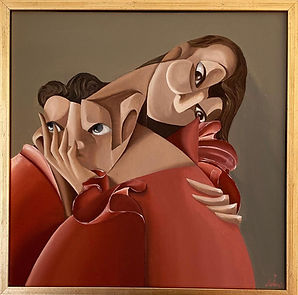
Figure 4. Nil Büyükbayraktar, Mom and Son (2022), 40×40 cm, oil on canvas yağlıboya tablo.
Eserde anne ve çocuğun yüzleri, spiral bir kıvrılma dinamiği içinde birbirine eklemlenen çoklu yüz parçalarıyla temsil edilir. Figürler kırmızı tonlarda ortak bir bedensel alanı paylaşırken, bakışlar hem içe hem dışa doğru çoğalan bir duygulanım alanını işaret eder. Yapıt, sanatçının Somatik Spiralizm yaklaşımındaki “birleşik beden”, “somatik iz” ve “çift yönlü spiral zaman” kavramlarının yoğunlaşmış bir örneğidir.
1.TEKNİK ANALİZ
1. Yağlıboya plastisitesi ve yüzey kontrollü geçişler
Büyükbayraktar, yüz parçalarını heykelsi bir pürüzsüzlükle modellersen, açık-koyu geçişleri minimal kontrastlarla çözer. Bu sayede figürlerin yüzeyleri tek bir zar gibi akar.
Kırmızının farklı saturasyonları, duygusal gerilimi arttırırken formun birleşik akışını sürdüren bir enerji alanı yaratır.
2. Keskin kıvrımlar ve dokunsal hacim
El ve kumaş kıvrımları, somut bir dokunsallık yaratacak biçimde kalın ve kıvrımlı boyasal modellerle yapılmıştır. Özellikle kırmızı kumaşın kıvrımları, eserdeki spiral hareketin dış katmanı gibi işlev görür.
2.SOMATİK ANALİZ
1. Birleşik beden hâli (somatik yakınlık)
Eserde anne ve çocuk iki ayrı beden değil, birbirine “spiral olarak bağlanan tek bir varlık” gibidir. Çocuğun yüzü annenin yüzündeki kıvrımların devamı gibi görünür. Bu, Somatik Spiralizm’deki “dönüşün bedenleşmesi” ilkesinin somatik karşılığıdır.
2. Bakışların somatik rezonansı
Çocuğun yukarı doğru çekilmiş, korunaklı ama tetikte olan bakışı; annenin yumuşak, yatay ve kapsayıcı bakışıyla rezonans kurar. İki duygu durumu tek bir yüzeyde birleşip çoğalır.
Bu, bedensel hafızanın kuşaklar arası devridaimini temsil eder.
3. Somatik iz olarak el teması
Anne elinin çocuğu kavrayışı, spiral bir kalkan gibi sararak “somatik iz” yaratır. Bu iz yalnızca bir temas anı değil, bakım, korunma ve korkunun eşzamanlı kaydıdır.
3.TOPOLOJİK ANALİZ
1. Tek yüzeyde çoklu topoloji
Figürlerin yüzleri kesintisiz bir kıvrım yüzeyi gibi işlenmiştir. Annenin yüz çizgileri çocuğun yüz düzlemine bağlanır; hatlar sürekli yön değiştirir ama kopmaz.
Bu durum, topolojik olarak “ayrılabilir ama ayrışmayan” bir bedensel bütünlük yaratır.
2. Spiral yakınsama ve uzaklaşma
Yüz parçalarındaki yön değişimleri spiral yakınsama (anne) ve spiral uzaklaşma (çocuk) hareketlerini eşzamanlı işler. Bu topolojik düalizm, Somatik Spiralizm’deki “çift yönlü spiral akış” ilkesine paraleldir.
3. Kırmızı kumaşın spiral çerçeve işlevi
Kumaş kıvrımları figürleri içten dışa doğru çepeçevre sararak bir spiral çerçeve üretir. Beden bu çerçeve içinde hem korunur hem yeniden şekillenir.
4.SOMATİK SPİRALİZM BAĞLAMINDA YOĞUN KURAMSAL ÇÖZÜMLEME
Nil Büyükbayraktar’ın Somatik Spiralizmi, “varlığın dönerken kendini çoğaltması” ilkesine dayanır . Mom and Son, bu çerçevede özellikle birleşik beden, çok-katmanlı spiral zaman ve somatik iz kavramlarını temsil eden güçlü bir örnektir.
1. Spiral Ontoloji: Birleşik bedenin oluşu
Anne ve çocuk tek bir spiral ontolojik alanın iki kıvrımıdır.
Büyükbayraktar’a göre spiral beden “birbirine eklemlenen, fakat asla tam ayrışmayan bir çokluklar alanıdır” (2024).
Eserde bu çokluk, tek bir yüzeyde kıvrılan yüz parçalarıyla görünür olur.
2. Beden Temelli Epistemoloji: Bilgiyi taşıyan bakışlar
Anne ve çocuğun bakışları farklı yönlerde fakat aynı bedensel hafıza düzleminde yer alır.
Çocuğun bakışı geleceğin habercisi; anneninki geçmişin deneyimlerini taşıyan bir sığınak niteliğindedir.
Bu eşzamanlılık Spiralizmin “çok-katmanlı spiral zaman” ilkesinin doğrudan görsel karşılığıdır.
3. Somatik İz: Dokunmanın kaydı
Annenin çocuğu kavrayışı, fiziksel bir dokunuştan öte, zihinsel ve duygusal kayıt barındırır.
Spiral beden, “dokunulan yerde kıvrılarak yeni bir katman oluşturur”
Eserdeki el temasları bu yeni katmanların oluşum yerleridir.
4. Spiral Akış Dinamiği: Koruma ve kırılganlık
Kırmızı kıvrımlar hem bir koruyucu duvar hem de kırılgan bir zar gibidir.
Spiral akış çocuğu merkeze alarak dışa doğru genişler.
Bu, spiralizmin “dönüşün bedenleşmesi” sloganının uygulamalı halidir.
KAYNAKÇA
Merleau-Ponty, M. (1962). Phenomenology of Perception. Routledge.
Sheets-Johnstone, M. (2011). The Primacy of Movement. John Benjamins.
Deleuze, G. (1988). The Fold: Leibniz and the Baroque. University of Minnesota Press.

Figure 5. Nil Büyükbayraktar (birnil), Noon, 2022, oil on canvas yağlıboya tablo, 180 × 120 cm. Eserde, spiral formasyonlarla iç içe geçmiş yedi figür, keskin kırmızı bir fon üzerinde yarı-grafik, yarı-organik bir mekânsal alanı birlikte işgal eder. Bedenlerin bükülme, içe kıvrılma ve birbirine eklemlenme biçimleri, sanatçının Somatik Spiralizm doktrininde tanımladığı “bedensel süreklilik” ve “spiral zaman” kavrayışlarını görselleştirir.
1.TEKNİK ANALİZ
Bu çalışma, Büyükbayraktar’ın tipik teknik karakteristiğini taşıyan yumuşak geçişli yağlı boya modellemeleri, interlocking yüzey kurguları ve spiral segmentasyonlu anatomik parçalanmalar içerir. Figürlerin yüzleri, kolları ve gövdeleri keskin kenarlı geometrik bloklarla değil, sürekli akış halinde olan oval–spiral kıvrımlar ile oluşturulmuştur. Bu teknik, bedensel formun hem sabit hem akışkan olabileceği yönündeki çağdaş beden teorilerindeki argümanlarla örtüşür (Merleau-Ponty, 1962).
Renk paleti belirgin biçimde üç katmanlıdır:
(1) Nötr bej-beyaz giysi spiralizasyonu
(2) Açık cilt tonları ile oluşturulmuş yumuşak yüz ovalizasyonları
(3) Düz, kesintisiz kırmızı arka plan — figürleri hem sahneleyen hem de sıkıştıran dramatik bir yüzey
Büyükbayraktar, fırça darbesini görünmezleştirme pratiğiyle pürüzsüz bir plastik yüzey kurar. Bu, spiral formun “kesintisiz birlik” etkisini güçlendirir.
2.SOMATİK ANALİZ
Bu eserde bedenler, biyolojik bedenin sınırlarını aşarak kolektif bir somatik organizma gibi davranır. Her bir figür, spiral kıvrımlar aracılığıyla diğerine dokunur, ona eklemlenir, onunla aynı solukta var olur. Bu durum, somatik disiplinlerde sıkça tartışılan “birlikte bedenlenme” (co-embodiment) fikrini çağrıştırır (Sheets-Johnstone, 2011).
Eller figürler arasında yön gösterir, birbirine işaret eder, birbirini sarar.
Boyunlar uzar, katmanlaşır, spiralleşir.
Bedenler sanki ortak bir nefes ritmi sürdürür.
Bu somatik yakınlık, bireyler arası sınırların bulanıklığını ve bedenin birbirine karışabilirliğini vurgular. Büyükbayraktar’ın figürleri hiçbir zaman anatomik süreklilik kaygısı taşımaz; aksine, bedensel formun duygulanımsal konfigürasyonlar halinde yeniden düzenlenmesini araştırır.
3.TOPOLOJİK ANALİZ
Bu çalışma, Somatik Spiralizm’in topolojik mantığını güçlü biçimde açığa çıkarır. Figürlerin oturduğu/üstünde durduğu form hem bir masa, hem de yarım bir kapsül/geometrik çanak gibidir. Bu iki-anlamlılık, mekânın hem iç hem dış olabilen topolojik yapısını ifade eder (Deleuze & Guattari, 1987).
Topolojik açıdan:
Kırmızı fon, arka plan olmaktan çok ritüel bir mekânsal yüzey gibi davranır.
Ön plandaki büyük yeşilimsi form, kap/kaplama/topolojik yüzey işlevi görür.
Figürlerin bedenleri topolojik birer düğüm gibi birbirine bağlanır.
Hiçbir beden tam olarak ayrı değildir; tüm yüzeyler geçirgendir.
Eserdeki topolojik örgütlenme, Somatik Spiralizm’in “spiralin mekânsal-zamansal süreklilik kurduğu” iddiasını somutlaştırır.
4.SOMATİK SPİRALİZM BAĞLAMINDA KURAMSAL ÇÖZÜMLEME
Büyükbayraktar’ın Somatik Spiralizm manifestosundaki temel düşüncelerden biri, “Varlık döner; dönüş bedenleşir; beden resme dönüşür.” Bu eser, resmin tamamına yayılmış spiral-latent formun somutlaşmış bir örneğidir. Figürlerin iç içe geçmiş omuzları, parmaklarının tekrarlayan ritmi, yüzlerin spiral simetri içinde kayması, zamanın spiral akışının bedeni nasıl katladığını gösterir.
Somatik Spiralizm çerçevesinde üç temel kavram burada belirginleşir:
1. Spiral Ontolojisi — beden, bir varlık değil bir dönüş hareketidir
Eserdeki her figür, spiral bir momentin farklı bir fazı gibidir; başlangıç ya da bitiş yoktur. Bu, Bergson’un süre kavramıyla paraleldir: “Hareket, durağan anların toplamı değil, kesintisiz bir akıştır” (Bergson, 1911).
2. Beden Temelli Epistemoloji — bilme, bedenin katlanmasıyla oluşur
Figürlerin birbirine yaslanma ve birbirinin düşünce/duygu hacmini taşır gibi görünmesi, bilginin bedenler arasında spiral biçimde dolaştığına işaret eder (Sheets-Johnstone, 2011).
3. Spiral Mekân — düzlem halindeki kırmızı fon, bir bedenleşme alanına dönüşür
Arka plan spiral değildir; fakat figürlerin spiral formu, fonu kendisine doğru çeker, onu “spiral titreşimli” bir mekâna dönüştürür. Bu, Somatik Spiralizm’de mekânın edilgen değil, beden tarafından dönüştürülen bir yüzey olduğunu açıklar.
KAYNAKÇA
Bergson, H. (1911). Creative evolution. Henry Holt.
Deleuze, G., & Guattari, F. (1987). A thousand plateaus: Capitalism and schizophrenia. University of Minnesota Press.
Merleau-Ponty, M. (1962). Phenomenology of perception. Routledge & Kegan Paul.
Sheets-Johnstone, M. (2011). The primacy of movement. John Benjamins
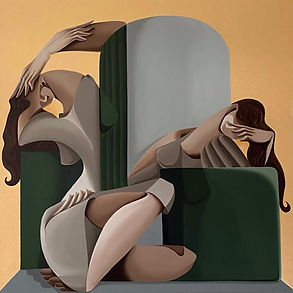
Figure 6. Nil Büyükbayraktar, Parfume, 2022–2025 dönemine ait figüratif-somatik soyutlama. Tuval üzerinde yağlıboya. Kompozisyon, iki figürün eğilip bükülen bedenlerini, spiral hareketin sürekliliğini ve içsel akışın mekânla kurduğu topolojik ilişkiyi vurgular. Bedenler, mimari bir niş, bloklaşmış formlar ve yumuşak geçişli tonlarla hem içsel hem çevresel bir kıvrılma hareketine bağlanır.
1.TEKNİK ANALİZ
Eserde pürüzsüz geçişlere sahip degrade yüzeyler, açık form modellemeleri ve blok renk mekânları dikkat çekmektedir. Figürlerin anatomisi, kübist parçalanmışlık yerine, Büyükbayraktar’ın özgün yaklaşımı olan somatik kıvrım ile yeniden inşa edilir. Beden gölgeleri, içbükey ve dışbükey yüzeylerin sürekli dönüşümünü destekleyen incelikli airbrush benzeri geçişlerle verilmiştir.
Renk paleti çoğunlukla toprak, bej, zeytin yeşili ve nötr griler üzerine kuruludur; bu palet figürlerin iç dünya sessizliğini mekânın dinginliğiyle bütünleştirir.
2.SOMATİK ANALİZ
Büyükbayraktar’ın figürleri, dış dünyayı temsil etmekten çok bedenin kendi duyumsal arkeolojisine odaklanır. Buradaki iki figür, birbirine paralel olarak konumlandırılmış fakat içsel jestlerle birbirlerine dolanan bir bedensel yankı üretir.
Ellerin yüzü kısmen örtmesi, içsel dinlemeye işaret eder.
Dizlerin bükülmesi, gövdenin kıvrılması ve bedenin mekânı “kendine çekip eğmesi”, somatik iç akışın dışa yansımasıdır.
Figürler birbirine bakmaz; bedenler konuşur ve “dönüş” dili ortak bir kinestetik alan yaratır.
Bu bağlamda eserin somatik dili, Merleau-Ponty’nin bedenin “dünya ile ortak bir dokunma alanı kurduğu” fikriyle paraleldir (Merleau-Ponty, 1968).
3.TOPOLOJİK ANALİZ
Eserin mekânsal kurgusu, klasik perspektifi reddederek topolojik bir yüzey sürekliliği kurar:
Yeşil bloklar bir yandan mobilyayı andırırken, diğer yandan figürlerin uzuvlarıyla aynı eğrisel akışa bağlanır.
Kompozisyonun merkezindeki kemerli gri alan, eşik-topolojisi oluşturur; figürlerin bedensel dönüşü bu eşiği hem ayıran hem birleştiren bir portal gibi işler.
Figürlerin kıvrımları ile mekânın kıvrımları arasında “katmanlar arası geçiş” söz konusudur. Bu, Deleuze’ün “kıvrım ontolojisi”ne yakındır (Deleuze, 1993).
4.SOMATİK SPİRALİZM BAĞLAMINDA KURAMSAL ÇÖZÜMLEME
Nil Büyükbayraktar’ın kurduğu Somatik Spiralizm ekolünün temel ilkeleri olan spiral ontolojisi, beden temelli epistemoloji, spiral zaman ve çok-katmanlı akış bu eserde belirgin biçimde görünür.
1. Spiral Ontolojisi: Bedenin Varlık Kıvrımı
Figürlerin anatomik yapıları, doğrusal hareket yerine dönüşsel, süreksiz-sürekli bir kıvrım üzerinden kurulmuştur.
Diz–kalça–gövde hattındaki eğrisel kesintiler, spiral formun bedensel izdüşümüdür.
Kolların başla birleştiği noktalarda spiral kapanışlar oluşur.
Bu, ekoldeki “Varlık döner; dönüş bedenleşir” ilkesinin somut bir karşılığıdır
2. Somatik Epistemoloji: Bedenin Bilgiyi Üretmesi
Figürlerin yüzlerini kapaması, gözden değil bedenden öğrenilen bir bilgi alanına gönderme yapar.
Bu jestler, somatik farkındalığın bilgi üretme biçimlerini temsil eder. Bu durum Sheets-Johnstone’un “hareketin bedensel düşünce olduğu” savıyla uyumludur (Sheets-Johnstone, 2011).
3. Spiral Zaman ve Çok-Katmanlı Akış
Kompozisyonda zaman, ardışık değil eşzamanlı katmanlar hâlinde görünür.
Soldaki figürün yükselen kolu,
Sağdaki figürün içe kapanan koluyla
zaman içinde farklı hareket yönleri temsil eder.
Bu karşıt yönlü akış, spiral zamanın geri dönen ama aynı noktaya dönmeyen yapısına karşılık gelir.
4. Topolojik Spiral Mekân
Mekânın kavisleri, blok yüzeyleri ve beden kıvrımları aynı spiral akışa bağlanır. Böylece mekân “sabit dış çevre” olmaktan çıkar, bedensel dönüşün bir uzantısına dönüşür.
Somatik Spiralizm’de mekânın bedensel akışa katılması, ekolün “spiral akışın resim yüzeyine süreksiz süreklilikle kaydedilmesi” ilkesini görünür kılar.
KAYNAKÇA
Deleuze, G. (1993). The fold: Leibniz and the Baroque (T. Conley, Trans.). University of Minnesota Press.
Merleau-Ponty, M. (1968). The visible and the invisible (C. Lefort, Ed.; A. Lingis, Trans.). Northwestern University Press.
Sheets-Johnstone, M. (2011). The primacy of movement (2nd ed.). John Benjamins.

Figure 7. Nil Büyükbayraktar (birnil), Fantasia, 2023, tuval üzerine yağlıboya, 190 × 140 cm.
Eserde, üst üste binen çoklu figürlerden oluşan yoğun bir kompozisyon, kıvrımlı beden yüzeyleri ve tekrar eden pozlarla spiralimsi bir kütle oluşturur. Renk alanlarının (yeşil–pembe–ten tonları) ritmik dağılımı, figürlerin hem ayrıştığı hem tek bir bedensel organizma gibi bütünleştiği dairesel bir hareket duygusu yaratır.
1.TEKNİK ANALİZ
Eser, dikey formatın verdiği “yığılma” etkisini avantaja çevirerek bedenlerin aşağıdan yukarıya doğru çoğalan bir kütle olarak algılanmasını sağlar. Nil Büyükbayraktar, formu belirgin kılmak için pürüzsüz gradyan geçişleri, yumuşak gölgelendirme ve anatomik parçaların stilize bir biçimde kurgulanmasıyla kendine özgü plastik dilini sürdürür (Arnheim, 1974).
Teknik olarak üç ana unsur öne çıkar:
1.1. Renk Katmanları
Yeşil ve pembe ton blokları, figürleri hem ayıran hem de tekrarlayıcı bir ritimle bütünleştiren bir yapısal işlev görür. Renk, hacimden bağımsız bir “akış çizgisi” yaratır.
1.2. Figürlerin Tekrarlı Yapısı
Neredeyse aynı yüz hatlarına sahip olan çok sayıda karakter, kompozisyonda bir “çoğalma ritmi” oluşturur. Bu, fiziksel bir kalabalıktan çok bedensel varyasyonların sürekliliğini çağrıştırır.
1.3. Işık-Yüzey Anlatısı
Işık kaynağı yumuşaktır; yüzeyler pürüzsüz ve porselenimsi görünür. Bu, bedenlerin soyutlanmışlığına katkıda bulunur ve her figürün bireyselliğinden çok bütünsel yüzey hareketini vurgular.
Arka planın tek renkli, nötr kahverengi alanı, figürler için dramatik bir sahne oluşturur; hareketli ve karmaşık beden düzeniyle keskin bir karşıtlık sağlar.
2.SOMATİK ANALİZ
Somatik olarak eser, bedensel ortaklaşma, toplu dinlenme, birlikte kıvrılma gibi duyusal hâlleri merkezine alır. Tekil bedenlerin birbirine temas ettiği sayısız nokta, proprioseptif bir örgü modeli yaratır (Eddy, 2009).
2.1. Toplu Duyumsama
Figürlerin çoğunun gözlerinin kapalı olması, hareketten çok içsel duyuma yönelmiş bir bedensel hâli temsil eder. Bu kapanış, izleyiciye “sessiz bir ortak nefes alma” hissi verir.
2.2. Tensel Kümelenme
Kolların, bacakların ve gövdelerin birbirine dolanması, somatik dünyada “temas yoluyla bütünleşme”yi yansıtır (Foster, 2011). Bedenler ayrışmak yerine ortak bir yüzey oluşturur; sınırlar bulanıklaşır.
2.3. Duyusal Spiral Yoğunluğu
Kompozisyonun ortasındaki figürlerin daha sıkışık, kenarlara doğru daha gevşek olması, somatik yoğunluğun merkezden çevreye spiral bir dağılım gösterdiğini ima eder.
3.TOPOLOJİK ANALİZ
Bu eser, Büyükbayraktar’ın işlerindeki temel topolojik kavramları net biçimde taşır.
3.1. Çoklu-Yüzey Manifoldu
Figürler, ayrı bedenler olmaktan çıkarak tek bir geniş yüzey gibi davranan bir topolojik manifold oluşturur. Kimin kolunun kime ait olduğu takip edilemez; yüzey tekil değil çokludur.
3.2. Kıvrım (Fold) Yapısı
Deleuze’ün kıvrım kavramının (2006) açık bir görsel karşılığı vardır: beden yüzeyleri kendi üzerine katlanarak hem süreklilik hem belirsizlik yaratır. Bedenler düz bir yüzeyde değil, sürekli bükülen bir topolojik uzamda konumlanır.
3.3. Yığınlaşma vs. Akış
Her ne kadar figürler yığılmış gibi görünse de, bedenlerin yönleri spiralimsi bir akışla düzenlenmiştir. Tekrarlanan figür pozisyonları, kompozisyonu bir “döngü çizgisi” gibi işler.
4.SOMATİK SPİRALİZM BAĞLAMINDA KURAMSAL ÇÖZÜMLEME
Nil Büyükbayraktar’ın geliştirdiği Somatik Spiralizm ekolünün temel unsurları bu eserde son derece belirgindir.
4.1. Spiral Ontolojisi: Çoklu Varlık Birliği
Somatik Spiralizm’e göre varlık “çoğalan, dönen, katlanan ve kendine eklemlenen bir süreçtir”. Bu eser, spiral ontolojiyi hem figür çoğalması hem yüzey sürekliliği yoluyla tezahür ettirir.
Bedenler, spiral bir örgü gibi birbirine eklenmiş, ayrışmaz ve tekil bir akış hâline gelmiştir.
4.2. Beden Temelli Epistemoloji: Duyumsayarak Bilme
Figürlerin kapanmış gözleri, bedensel bilginin dıştan değil içsel duyumdan üretildiği Somatik Spiralist düşünceyle uyumludur. Bilme, görmekten değil duymaktan geçer.
4.3. Çok-Katmanlı Spiral Zaman
Eserdeki figür tekrarları, spiral zamanın döngüsel, fazlı yapısını çağrıştırır. Her figür, bir öncekinin varyasyonu gibidir; zaman çizgisel değil spiral büyüme şeklindedir.
4.4. Spiral Akış Dinamiği
Bedenlerin dikey eksende yoğunlaşması ve spiralimsi bir yönelimle örgülenmesi, Somatik Spiralizm’in “akışın kendini sürekli yeniden kıvırarak ilerlemesi” kavramını görsel olarak somutlaştırır.
KAYNAKÇA
Arnheim, R. (1974). Art and visual perception: A psychology of the creative eye. University of California Press.
Deleuze, G. (2006). The fold: Leibniz and the baroque (T. Conley, Trans.). University of Minnesota Press. (Original work published 1988)
Eddy, M. (2009). A brief history of somatic practices and dance: Historical development of the field of somatic education. Journal of Dance and Somatic Practices, 1(1), 5–27.
Foster, H. (2011). The art-architecture complex. Verso.

Figure 8. Nil Büyükbayraktar (birnil), Mother and Daughter, 2023, tuval üzerine yağlıboya, 150 × 130 cm.
Eser, sarı bir fonda organik spiral kıvrımlarla birbirine geçmiş iki bedenin küresel bir hacim oluşturduğu kompozisyonu; dikey yeşil perde formu ve sağ üstte yer alan karanlık küresel kütle ile birlikte sunar.
1.TEKNİK ANALİZ
Eserde renk alanları net şekilde ayrılmıştır: geniş sarı zemin, derin yeşil perde formu ve gölgeli-ışıklı küresel obje soyut mekânsal unsurlar oluşturur. Bedenler, Büyükbayraktar’ın karakteristik “pürüzsüz hacim” tekniği ile modellenmiştir: kesintisiz gradyan geçişleri, hacimlerin adeta porselen bir yüzey gibi görünmesini sağlar (Arnheim, 1974).
Tonlama yapısında ışık kaynağı açıkça belirlenmez; bu, bedenlerin heykelsi bir soyut yüzey olarak algılanmasını güçlendirir. Pembe–ete tonları, gövdelerin spiral kütle formunu vurgular; kıvrımların keskin geometrik kesitlerle bir araya gelmesi, organik ve mimari dilin birleştiği bir yapı yaratır.
Dikey yeşil perde, ritmik bir çizgisel modülasyon sunarak bedenlerin yumuşak kıvrımlarıyla kontrast kurar. Sağ üstteki koyu yeşil-küresel form ise kompozisyonun denge noktasını oluşturur; hem ağırlık merkezi hem de figürsel kütlelerin yönsüzlüğüne karşı bir gerilim alanı yaratır.
2.SOMATİK ANALİZ
Eserin somatik düzeyi, iki bedenin –muhtemelen anne ve çocuk– birbirine doğru kıvrılarak oluşturduğu yakınlık alanı üzerine kuruludur. Bedensel sınırlar geçirgendir; kimin kolunun, dizinin, gövdesinin nerede başladığı bilinçli biçimde çözümlenemez. Bu somatik belirsizlik, duygulanımsal yoğunluğun bir sonucu olarak okunabilir (Foster, 2011).
Bedenlerin spiral biçimde birbirine sarılması, temasın sürekliliğini artırır; izleyicinin proprioseptif empati mekanizmasını tetikler. Anne–çocuk ilişkisine özgü “dokunarak öğrenme” ve “tensel hafıza” gibi somatik temalar, kıvrımların iç içeliğinde görünür hâle gelir (Eddy, 2009).
Sarı zemin, bedensel sıcaklığa benzer bir duygulanım alanı yaratır; figürlerin pembe tonlarıyla birleştiğinde “içsel ısı, yakınlık ve korunma” hissini yoğunlaştırır.
3.TOPOLOJİK ANALİZ
Bu çalışma, geniş yüzeyler yerine katlanan, kıvrılan ve kendi üzerine bükülen süreksiz yüzeylerin bir araya gelmesiyle oluşan bir beden topolojisine sahiptir. Bedenler lineer bir mekânda durmaz; birbirlerinin yüzeylerini katlayan içbükey–dışbükey geçişler oluşturur.
Topolojik açıdan figürler, tek bir çok-katmanlı yüzey gibi davranır:
Yüzey dışa doğru genişler,
Daha sonra içeri kıvrılır,
Ardından tekrar dışarı taşar.
Bu, Deleuze’ün “katlanma” kavramında tarif ettiği içsel yoğunluk halkalarına benzer (Deleuze, 2006). Yeşil perde, dikey bir yüzey olarak bu organik kıvrımı kesintiye uğratır; perde kıvrımlarının düzeni, beden kıvrımlarının düzensiz organikliğini topolojik bir karşıtlık üzerinden görünür kılar.
Sağdaki küresel form ise “uzamsal bir boşluk çekirdeği” gibi davranır; bedenlerin topolojik akışını dışa doğru açan veya merkeze çeken bir alan etkisi yaratır.
4.SOMATİK SPİRALİZM BAĞLAMINDA KURAMSAL ÇÖZÜMLEME
Nil Büyükbayraktar’ın Somatik Spiralizm ekolü; bedensel deneyimin dönüşsel hareketleri, çoklu zaman katmanları ve somatik izlerin formlaşması üzerine kuruludur. Bu eser, ekolün temel kavramlarının örnek bir temsili niteliğindedir.
4.1 Spiral Ontolojisi: Bedenin Varlık-Dönüş Hâli
Anne ve çocuğun bedenleri, doğrusal bir pozdan ziyade spiral bir varlık hâli içindedir. Yüzeyler, merkeze bükülür ve tekrar dışa açılır; bu dönüş hareketi figürlerin ontolojik ortaklığını görünür kılar. Burada spiral, sadece form değil; iki beden arasındaki varoluşsal bağın somutlaşmış hâlidir
4.2 Somatik İz: Yakınlığın Bedensel Hafızası
Çocuk ve ebeveyn arasındaki ilk somatik kayıtlar –dokunma, sarılma, korunma– eserde spiral kıvrımlar şeklinde ortaya çıkar. Spiralizm’in “bedenin hatırlama kapasitesi” burada açıkça görünür olur. Kıvrımlar tensel hafızanın izleridir.
4.3 Çok-Katmanlı Spiral Zaman: Annelik Döngüselliği
Figürler tek bir anı yansıtmaz; çoklu zamanların eşzamanlı görünürlüğünü üretir:
çocukluk,
annelik,
korunma,
büyüme,
birbirine sarılma döngüleri…
Sarmal form, Spiralizm’in zaman anlayışını temsil eder: zaman ileri gitmez, katlanır, tekrar eder, merkezden dışa doğru genişler.
KAYNAKÇA
Arnheim, R. (1974). Art and visual perception: A psychology of the creative eye. University of California Press.
Deleuze, G. (2006). The fold: Leibniz and the baroque (T. Conley, Trans.). University of Minnesota Press. (Original work published 1988)
Eddy, M. (2009). A brief history of somatic practices and dance: Historical development of the field of somatic education. Journal of Dance and Somatic Practices, 1(1), 5–27.
Foster, H. (2011). The art-architecture complex. Verso.

Figure 9. Stone (2023), Nil Büyükbayraktar (birnil). Tuval üzerine yağlıboya, 120 × 100 cm. Eserde bedenlerin sıkışma, katlanma ve içe kıvrılma hareketleri aracılığıyla hem savunma hem de içsel yoğunlaşma barındıran bir “toplanma–yuvalanma” formu oluşturduğu
görülmektedir. Boş ve nötr arka plan, figür kümesini mekânsal olarak izole ederek somatik ve topolojik yoğunluğu artırır.
1.TEKNİK ANALİZ
Eser, tuval üzerine yağlıboya tekniğiyle çalışılmış olup Büyükbayraktar’ın karakteristik biçimsel dili —oval hacimler, keskinleşmiş konturlar, katlanmış ekstremiteler, minimalist yüz ifadeleri— belirgindir. Renk paleti sıcak bej, kırmızımsı et tonları ve koyu yeşiller arasında kurulmuştur; bu palet, hacimsel formu destekleyen yumuşak geçişlerle modelleme etkisini güçlendirir.
Kompozisyon, yüzeyin alt kısmında yoğunlaşan figür kümesinin üst kısmında devasa bir negatif alanla karşıtlık oluşturur. Bu alanın genişliği, figürlerin içine kıvrılıp kapanma jestlerini optik olarak daha da yoğunlaştırır. Büyükbayraktar’ın tipik “somatik kubbe” (bedenlerin üst üste binerek yarı-kubbe geometrisi oluşturması) yaklaşımı bu işte belirgin bir konstrüksiyon mantığına sahiptir.
Fırça darbeleri görünmez hâle gelecek kadar pürüzsüz bir yüzey anlayışıyla uygulanmış; bu da eserin hem heykelsi hem de dijital-benzeri bir bütünlüğe sahip olmasını sağlar. Biçimler sade ama hacimlidir; ışık yönü tekil değil, çoklu kaynaklıdır ve bedenlere heykelsi bir plastik değer kazandırır (Arnheim, 1974).
2.SOMATİK ANALİZ
Büyükbayraktar’ın resminde bedenler, anlatının değil, duyumun taşıyıcılarıdır. Bu eserde bedensel pozisyonlar koruyucu kasılma, yerle bütünleşme, toplanma, büzülme ve diz çökmeye yakın çömelme etrafında biçimlenir. Üstteki figürün geniş omuzları ve kolları, alttaki figürü yarı-çevreleyen bir kapsayıcı jest üretir. Bu jest Somatik Spiralizm’de “içbükey kapanma” olarak kavramsallaştırılır.
Yüz ifadeleri durağan fakat duyusal bir yoğunluk taşır: gözler kapalı, nefes döngüsünün iç ritmine çekilmiş hâlde. Formların spiral benzeri kıvrımları, omurganın somatik tonusunu açık eden çizgisel kıvrımlarla desteklenir. Eser bir anlatıdan ziyade bir bedensel hâl durumu sunar: korunma, içe dönme, kabuklanma ve içsel titreşimle taşlaşma.
3.TOPOLOJİK ANALİZ
Eserin topolojik yapısı, bedenlerin “yuvarlanmış–katlanmış–içe kıvrılmış” sürekli bir yüzey oluşturması üzerine kuruludur. Büyükbayraktar’ın figürleri, Öklidyen mekânda değil, beden-ilişkisel bir manifold üzerinde dağılan yüzeyler gibi davranır.
Burada üç temel topolojik özellik öne çıkmaktadır:
İçbükey Kapsama (Concave Enclosure). Üstteki figürün kol-bacak hacimlerinin yarattığı içbükey yüzey, alttaki figürü topolojik olarak “tutan” bir yapı oluşturur.
Yüzey Sürekliliği. Bedenler arasında keskin sınırlar yoktur; kol bir başka bedenin bacağına, omuz bir diğerinin sırtına yüzeysel olarak akar. Bu “akış” Somatik Spiralizm’in spiral bağlantı kavramını tek bir topoğrafyaya dönüştürür (Deleuze & Guattari, 1987).
Negatif Alanın Topolojik Bir Çanak Olarak İşlevi. Üstteki dev boş alan, figür kümesini bir “alt çanak” gibi konumlandırır; bu, yoğunlaşmış enerjinin bulunduğu noktayı mekânsal olarak sabitler ve izleyicinin bakışını aşağıya, bedensel kümeye çeker.
Bu yapı, resmin yalnızca figüratif değil, aynı zamanda topolojik bir organizma olarak okunmasını sağlar.
4.SOMATİK SPİRALİZM BAĞLAMINDA KURAMSAL ÇÖZÜMLEME
Nil Büyükbayraktar’ın kurucusu olduğu Somatik Spiralizm, bedenin spiral ontolojisine ve somatik izlerin çok-katmanlı zaman-mekân örgüsüne odaklanır. Bu eser, ekolün beş kurucu ilkesini somutlaştırır:
(1) Spiral Ontoloji – “Varlık döner.”
Bedenlerin kıvrımları, diz çökmeye yakın spiral kapanmalar ve birbirine dolanan hacimler, varoluşun temelinde döngüselliğin bulunduğu fikrini açığa çıkarır. Spiral form, burada dinamik değil, “dondurulmuş hareket” olarak görünür — bir tür taşlaşmış dönüş.
(2) Beden Temelli Epistemoloji – “Dönüş bedenleşir.”
Bilgi, bedensel jestlerde saklıdır. Figürlerin kapanma ve büzülme jestleri, korunmanın, derine inmenin ve içsel titreşimin bilgisel değerini taşır (Sheets-Johnstone, 2011).
(3) Somatik İz – Bedenin duyusal kalıntısı.
Her form, hareketin önceki anının izi gibidir. Omuzdaki yük, bacağın ağırlığı ve bedenlerin birbirine yaslanması, somatik hafızanın görsel karşılıklarıdır.
(4) Spiral Zaman – Çok-katmanlı an.
Eserde tek bir an değil, üst üste binmiş zaman katmanları hissedilir. Bedensel pozisyonlar sanki bir hareket dizisinin çakışmış kareleri gibidir (Merleau-Ponty, 1962).
(5) Spiral Akış Dinamiği – Akışın kıvrılarak yoğunlaşması.
Beden kümesinin alt kısmında yoğunlaşan spiral akış, üstteki buzlaşmış boş alanla gerilim yaratır. Somatik akış içe çöker; çöktükçe yoğunlaşır; yoğunlaştıkça taşlaşır — dolayısıyla eserin adı “Stone” hem literal hem de fenomenolojik anlamda yankılanır.
KAYNAKÇA
Arnheim, R. (1974). Art and visual perception: A psychology of the creative eye. University of California Press.
Deleuze, G., & Guattari, F. (1987). A thousand plateaus: Capitalism and schizophrenia (B. Massumi, Trans.). University of Minnesota Press.
Merleau-Ponty, M. (1962). Phenomenology of perception (C. Smith, Trans.). Routledge.
Sheets-Johnstone, M. (2011). The primacy of movement. John Benjamins.

Figure 10. Nil Büyükbayraktar (birnil), Mom (2025). Tuval üzerine yağlıboya, 140 × 80 cm. Eserde iç içe kıvrılan spiral beden formasyonları, figürler arası birleşik akış ve çok-katmanlı yüzey örgüsü dikkat çekmektedir. Kompozisyon, Somatik Spiralizm ekolünün “varlığın spiral ontolojisi” ilkesini figürler arası mekânsal dolanıklık üzerinden görünür kılar
1.TEKNİK ANALİZ
Eserde kullanılan monokromatik sıcak-nötr palet, figürlerin organik bütünlüğünü güçlendirmekte ve spiral geometrinin sürekliliğini vurgulamaktadır. Yağlıboyanın katmanlı uygulanışı, yüzeyde ipeksi ve mat geçişlerin birlikte kullanımına imkân tanımıştır. Bedenlerin kıvrılarak yükselen hatları, fırça darbelerinin yönüne paralel bir şekilde tasarlanmış olup, bu yaklaşım formun hareket hissini artırır (Arnheim, 1974).
Kompozisyon, ark oluşturulmuş bir niş içinde konumlandırılmıştır. Bu, figürleri hem mekânsal olarak çerçeveler hem de ikonografik bir sahne hissi yaratır. Kıvrımlı parçalı yüzeyler, gölge–ışık geçişleriyle “yontulmuş” bir derinlik izlenimi üretir. Bu yapı, eserin neredeyse heykelsi olarak algılanmasını sağlar.
2.SOMATİK ANALİZ
Büyükbayraktar’ın somatik yaklaşımı, figürün yalnızca dış konturunu değil, bedenin içsel titreşimlerini görünür kılmayı amaçlar. “Spiral somatik iz” kavramı, burada kas tonusu, nefes akışı ve duygusal yakınlığın iç içe geçişini temsil eder (Sheets-Johnstone, 2011).
Ana figürün gövdesinden yükselen kıvrımlar, annenin nefes ritminin beden formuna dönüştürülmüş izleridir. Çocuğun figürü ise bu spiral ritme uyumlanmış, bir tür kinestetik yakınlık alanı yaratmıştır. Bu durum, Somatik Spiralizm’in şu ilkesini görünür kılar: “Beden, duygunun mekânını örer; duygu spiral bir mimaridir.”
Parmakların uzun, kıvrımlı ve neredeyse nefes alan bir yapı gibi işlenmesi, dokunsallığın resimde birincil ifade gücü olduğuna işaret eder. Somatik düzeyde bu, anne–çocuk bağının “dokunma hafızası” üzerinden okunmasını sağlar (Fuchs, 2018).
3.TOPOLOJİK ANALİZ
Eserin uzamsal yapısı öklidyen olmayan, sürekli kıvrılan, birbirine eklemlenen yüzeylerden oluşmaktadır. Topolojik açıdan üç temel yapı öne çıkar:
Süreklilik (continuity): Bedenler birbirinden ayrılmadan tek bir yüzey gibi akar. Bu durum Somatik Spiralizm’in “tekil çokluk” kavramına karşılık gelir.
Dolanıklık (entanglement): Figürlerin uzuvları, sınırlarını belirsizleştirerek ortak bir gövdesel katman oluşturur.
Eşik mekânı (liminality): Niş formu, figürlerin içinde bulunduğu alanı yarı-ikonik bir çerçeveye dönüştürür; iç/dış sınırı geçirgenleşir.
Bu bağlamda eser, klasik figüratif mekândan ziyade topolojik bir yüzey organizasyonu olarak okunabilir (Deleuze & Guattari, 1987).
4.SOMATİK SPİRALİZM BAĞLAMINDA KURAMSAL ÇÖZÜMLEME
Nil Büyükbayraktar’ın Somatik Spiralizm ekolü, “varlığın döngüsel değil spiral bir hareketle belirdiği” fikrine dayanır. Bu eserde spiral hareket yalnızca çizgide değil, aynı zamanda duygusal yakınlığın topolojisinde de görülür. Bedenler birbirine doğru kıvrılırken, spiral akış bir duygu alanı üretmektedir.
Spiral ontoloji bağlamında, anne figürü “merkezkaç akış”, çocuk figürü ise “merkezcil spiral” olarak konumlanır; iki akış noktası karşılıklı olarak birbirini kurar
Somatik Spiralizm manifesto cümlesi olan
“Varlık döner; dönüş bedenleşir; beden resme dönüşür.”
bu kompozisyonda neredeyse somut bir mimariye dönüşür.
Spiral kıvrımların ritmik tekrarları, beden-zaman ilişkisinde çok-katmanlı spiral zaman kavramını görünür kılar; burada figürlerin beraberliği yalnızca mekânsal değil, zamansal bir iç içelik üretir (Grosz, 2005).
Bu nedenle eser, yalnızca figüratif bir anne–çocuk teması değil, bedenlerin ortak spiral akışı içinde “birlikte oluş” hâlinin resimsel antropolojisini temsil eder.
KAYNAKÇA
Arnheim, R. (1974). Art and visual perception: A psychology of the creative eye. University of California Press.
Deleuze, G., & Guattari, F. (1987). A thousand plateaus: Capitalism and schizophrenia. University of Minnesota Press.
Fuchs, T. (2018). Ecology of the brain: The phenomenology and biology of the embodied mind. Oxford University Press.
Grosz, E. (2005). Time travels: Feminism, nature, power. Duke University Press.
Sheets-Johnstone, M. (2011). The primacy of movement (2nd ed.). John Benjamins Publishing.
1. Definition and Positioning
Somatic Spiralism is an original artistic movement situated within contemporary visual arts as a body-centered theory of form production, in which the spiral is articulated as an ontological, epistemological, and morphological principle.
Within this framework, the spiral is not approached as a historical decorative motif or a formal repetition, but as a structural manifestation of bodily movement, respiratory rhythm, temporal continuity, and affective intensity.
2. Foundational Assumption
The fundamental assumption of Somatic Spiralism is as follows:
Every visual form carries a kinesthetic continuity that passes through the body.
The spiral constitutes both the structural and perceptual form of this continuity.
Accordingly, the spiral is understood as:
-
the spatial trace of bodily movement,
-
the morphological counterpart of respiratory cycles,
the geometric expression of the relationship between time and the body.
3. Ontological Principle: Spiral Being
Somatic Spiralism conceives being not as a linear progression, but as a cyclical continuity that folds inward, intensifies, and reopens.
In this perspective, the spiral is not merely a form; it is the organizing principle of existence itself.
Painting is thus no longer regarded as a completed representational object, but as a temporal condensation of bodily movement.
4. Epistemological Principle: Somatic Knowledge
Somatic Spiralism positions itself critically against Cartesian mind-centered epistemologies.
According to this approach:
-
the body is not merely a perceptual surface,
-
the body is an epistemic field that produces, records, and transforms knowledge.
Pictorial knowledge does not emerge from pre-established conceptual schemas, but from the temporal intensities of bodily rhythms.
Knowledge, therefore, arises not through representation, but through the continuity of somatic movement.
5. Formal Principle: Somatic Gesture
The formal production model of Somatic Spiralism is grounded in the concept of somatic gesture.
Somatic gesture:
-
initiates the process of form through bodily impulse,
-
translates temporal flow into spatial continuity,
-
constructs the micro-dynamics of spiral morphology.
Gesture is not an expressive sign, but the condition of form’s emergence.
Thus, painting shifts from a subject-centered mode of expression toward a practice centered on bodily processes.
6. Principles of Pictorial Structure
Somatic Spiralism defines pictorial practice through three core principles:
6.1. Somatic Trace
Each line on the canvas carries the memory of bodily movement. This trace is not accidental but constitutes the graphic projection of spiral bodily orientations.
6.2. Multilayered Spiral Time
Works do not represent a single moment; they are formed through the spiral superposition of multiple temporal layers. Reading is cyclical rather than linear.
6.3. Spiral Flow Dynamics
Composition is organized around energetic rather than geometric centers, generating a continuous movement between expansion and concentration.
7. The Status of the Body
Within Somatic Spiralism, the body is not a represented object but the ontological ground that directly generates pictorial form.
The figure does not convey narrative; it produces movement.
Form precedes meaning.
The female body is not treated as a thematic category, but as a bodily center through which cycles of life, loss, birth, resilience, and continuity are articulated.
8. The Viewer and Perception
The viewer in Somatic Spiralism is not passive.
The gaze integrates into the pictorial process and expands the spiral flow.
Each viewer reconstructs the work through their own bodily memory.
The artwork is therefore not a closed object, but an open process reactivated through perception.
9. Aesthetic Position
The aim of Somatic Spiralism is not to produce spiral forms, but to:
-
render bodily rhythm visible,
-
establish movement as the ontological foundation of painting,
-
present the spiral not as an aesthetic motif, but as an intuitive articulation of existence.
This approach proposes an aesthetic framework that transcends the binary opposition between figuration and abstraction.
10. Conclusion and Foundational Principle
Somatic Spiralism constitutes:
-
an artistic movement,
-
a body-centered ontology,
-
a somatic epistemology,
-
an aesthetic system.
Its foundational principle is summarized as:
“Being turns; turning becomes embodied; the body becomes painting.”
This manifesto shall be regarded as the official reference text defining the historical origin, theoretical framework, and methodological foundations of Somatic Spiralism.
SOMATIC SPIRALISM ARTWORKS ANALYSES
Figure 1. Nil Büyükbayraktar (birnil), Dance (2020), 120 × 100 cm, oil on canvas. The composition presents a somatic-figurative structure where the body is multiple, curving, and dissolved in a spiral-axiomatic arrangement, with simultaneous opening of gestural and emotional fields.
1. TECHNICAL ANALYSIS
In the work, the figures are presented through deformation via multiple faces, superimposed arms, fluid torso structures, and rhythmic pink-gray tones. Nil Büyükbayraktar's characteristic technique of soft transitional modeling, smooth surface, spiralized plastic structure, and sculptural volumization is noticeable.
The use of a flat, matte warm yellow background allows the figure to gain a resonance within both an iconic and staged space.
The brushstrokes are refined to the point of being almost invisible; this approach withdraws the material reality of the figure and emphasizes its ontological-spiral transformation. This is consistent with Merleau-Ponty's proposition that "the body is always a living interface between the seen and the felt" (Merleau-Ponty, 1962).
2. SOMATIC ANALYSIS
The body in the work is based not on anatomical accuracy, but on a somatic trace carrying the body's feeling-memories. The proliferation of arms and faces represents not a singular self, but multiple states of consciousness of bodily experience.
The hands constantly shift around the face, creating a scene of emotion that oscillates between protection and exposure.
The emptiness, inner hollows, and curves in the torso point to the outward expression of the inner field of sensation.
The splitting of heads demonstrates the simultaneous existence of a dual experience of time in somatic memory—both what is and what is possible (Sheets-Johnstone, 2011).
This structure transforms the body from a passive object into a fluid subjective space.
3. TOPOLOGICAL ANALYSIS
Nil Büyükbayraktar's figures generally operate according to the principle of topological deformation: body parts are constructed not through classical volumetric anatomy, but through twisted surfaces, folded vectors, spiral curves, and multiple surface continuities.
In this work:
The arm and torso lines of the figure have a Moebius-like transition; the inside-outside, front-back relationships constantly shift.
The superposition of faces creates a multi-layered topological time; the figure represents not a single moment, but a continuous field of movement.
The twisted planes that create a seamless flow between the chest, shoulders, and facial features make visible not only the visible form but also the vanishing line of the form (Deleuze & Guattari, 1987).
This topological approach transforms the figure into “not a single body, but a changing surface.”
4. THEORETICAL ANALYSIS IN THE CONTEXT OF SOMATIC SPIRALISM
The fundamental concepts of Somatic Spiralism—spiral ontology, body-based epistemology, somatic trace, multi-layered spiral time, spiral flow dynamics—are clearly visible in this work.
a. Spiral Ontology
Each part of the figure is connected to the next by a twist; there are seamless spiral transitions between the arms, face, torso, and gestures. This is a direct visual representation of the expression “being rotates; rotation becomes embodied.”
b. Body-Based Epistemology
Knowledge emerges not in the fragmented image of the figure, but in its rotational movement. The body becomes an informational unit within a spiral flow. The proliferation of faces signifies the circulation of knowing between sensory fields.
c. Somatic Trace
The body is read as an energetic, not anatomical, record of lived experience. The emptiness within the body—precisely the “trace moving from inside to outside” in Somatic Spiralism—reveals the temporary identity of the body.
d. Spiral Time
On the one hand, there is the “frozen” movement of the arms in the air; on the other hand, the faces looking in different directions simultaneously evoke multiple planes of time. This structure visualizes the layered and simultaneous functioning of spiral time (Massumi, 2002).
e. Spiral Flow Dynamics
The entire composition creates its own space by curling within a dance figure. This dynamism fully realizes the proposition of Somatic Spiralism that “the rotation of the body transforms into a picture.”
REFERENCES
Deleuze, G., & Guattari, F. (1987). A Thousand Plateaus: Capitalism and Schizophrenia. University of Minnesota Press.
Massumi, B. (2002). Parables for the Virtual: Movement, Affect, Sensation. Duke University Press.
Merleau-Ponty, M. (1962). Phenomenology of Perception. Routledge & Kegan Paul.
Sheets-Johnstone, M. (2011). The Primacy of Movement (2nd ed.). John Benjamins.
Figure 2. Nil Büyükbayraktar (birnil), 3. 2021 Kompozisyon, 100 × 80 cm, oil on canvas. The work establishes a spiraling somatic dramaturgy with figures multiplying suddenly, intertwining body surfaces, and an intense red background.
1. TECHNICAL ANALYSIS
The composition bears the distinctive features of Büyükbayraktar's unique plastic language: fluid anatomical deformation, multifocal facial placement, bending.
The painting features a striking volumetric composition, softly transitional modeling, and a dramatic contrast of color fields.
The intense, saturated red of the background creates a strong tension with the skin tones of the figures. Red both creates a theatrical effect and strengthens the dramatic atmosphere of the inner connection between the figures.
The skin surfaces have a satiny, layered light transition; thus, the body functions more like a kinetic surface than a volumetric definition in classical figurative painting. The soft interruptions between the arms and faces give the painting a sculptural unity; they create the impression of spiral layers unfolding from a single block.
This plastic approach is consistent with the idea of "the continuous exchange between seeing and the tactile" (Merleau-Ponty, 1962).
2. SOMATIC ANALYSIS
Although the figures in the work belong to a single body, they embody multiple minds, multiple emotions, and multiple states of identity. This situation is directly related to Somatic Spiralism's proposition that "the body is not a fixed entity, but a constantly rotating field of experience."
The close, introverted yet simultaneously attentive arrangement of the faces creates a sense of connection – protection – intimacy.
The cyclical, almost enveloping positioning of the arms represents the figures "nesting" both into each other and into their own inner space.
The delicate yet sharp positions of the hands make the affective vibrations visible.
The upward-looking face of the lower figure represents an internal moment of association of somatic memory (Sheets-Johnstone, 2011).
Here, the body functions not as a single form, but as a sensing psychological topography.
3. TOPOLOGICAL ANALYSIS
The composition is highly amenable to reading with concepts of topological transformation:
a. Continuity
The body surfaces intertwine to form a continuity that is not knotted; This points to the transformation that Deleuze calls the "folding space of the body" (Deleuze, 1988).
b. Inside-Outside Reversibility
The spiral arms transform the figure's inner space into a permeable membrane that both protects and opens it to the outside; the boundary between inside and outside becomes topologically fluid.
c. Multiple Surfaces
Büyükbayraktar's characteristic multiplications of faces function like the folding of topologically different "viewpoints" onto the same surface. The faces function as different time-periods within the same body.
d. Spiral Formation
The curve of the arms and shoulders forms a distinct spiral loop; the geometry of the body has a spiral rather than a circular orientation.
This form produces not a fixed volume, but a moving surface of flow.
4. THEORETICAL ANALYSIS IN THE CONTEXT OF SOMATIC SPIRALISM
The work contains a direct visual representation of all the main concepts of Somatic Spiralism.
a. Spiral Ontology
The figures continue as a “state of becoming”; transforming, expanding, and intertwining surfaces reveal the spiral structure of being. Here, the spiral functions as both an ontological (being) and relational (bodies oriented towards each other) axiom.
b. Body-Based Epistemology
The body is not an object that carries knowledge, but a process that produces knowledge. The intertwining figures suggest that knowing occurs through bodily movement and proximity (Massumi, 2002).
c. Somatic Trace
Body tension, the gesture of embracing, the close contact of faces; all reveal the sensory traces of bodily experience. This trace is a form of kinesthetic memory, not anatomical (Sheets-Johnstone, 2011).
d. Spiral Time
The triple multiplication of faces produces not a single moment, but a spiral time experience where the past, present, and possible exist simultaneously.
e. Spiral Flow Dynamics
The entire composition is structured around spiral variations of a single main movement (wrapping/hug/circular merging). Bodies transfer the same movement to each other; this movement creates the internal rhythm of the painting.
Therefore, the work perfectly represents the proposition of Somatic Spiralism: “Being rotates; rotation becomes embodied; the body becomes the painting.”
REFERENCES
Deleuze, G. (1988). Foucault. University of Minnesota Press.
Massumi, B. (2002). Parables for the virtual: Movement, affect, sensation. Duke University Press.
Merleau-Ponty, M. (1962). Phenomenology of perception. Routledge & Kegan Paul.
Sheets-Johnstone, M. (2011). The primacy of movement (2nd ed.). John Benjamins.
Figure 3. Nil Büyükbayraktar (birnil), One Body, Three People (2021), 100 × 100 cm, oil on canvas. The composition, in which a single body is multiplied into three faces and three gestures, explores themes of spiral flow, topological bending, and somatic unity simultaneously.
1. TECHNICAL ANALYSIS
The work bears the defining elements of Büyükbayraktar's characteristic plastic language: fluid anatomical breaks, soft tonal transitions, interconnected volumes, wrinkled drape-effect arm forms, and multiple facial expressions.
The background, a neutral gray-green area, dramatically highlights the figures.
The body surfaces gain a sculptural unity through layered transitions of pink-nude tones.
The tubular curvature of the arms creates the characteristic "spiral bending" effect.
The subtly melancholic expressions on the faces convey the duality of “internal tension – emotional openness.” This modeling style evokes the concept of tactile vision; the body surfaces are rendered with almost fingertip sensitivity (Merleau-Ponty, 1962).
2. SOMATIC ANALYSIS
The figures begin as a single body, then multiply into three different emotional states and three different orientations. This triple multiplication functions not as somatic division, but as somatic expansion.
The gesture of the central figure points to an internal field of sensation.
The slight tilt of the head of the figure on the left evokes a sense of touch and sensitivity.
The figure on the right, with its neck extended forward and slightly reclined posture, carries the duality of “distance – observation.”
These three states can be read as three emotional layers of the same body. The body here functions as a “psychic map” (Sheets-Johnstone, 2011).
The delicate, linear structure of the hands embodies the emotional vibration of the body.
3. TOPOLOGICAL ANALYSIS
The work clearly operates on the principles of topological transformation and continuity.
a. One Body – Multiple Surfaces
A single body surface branches out through three separate “ends”; thus, the body is not divided, but diversified.
b. Folding
The arms, reminiscent of Deleuze’s concept of “fold,” curve, making the inside-outside relationship permeable (Deleuze, 1988).
c. Inside-Outside Continuity
The outwardly opening arms create a continuous flow field with the inwardly turning body curves; boundaries dissolve, the surface becomes continuous.
d. Spiral Topology
The curvature of the necks and arms creates a rotational movement; this movement functions as the fundamental geometric dynamic determining the position of the figures.
Thus, the composition presents a transforming spatial organization instead of a fixed volume.
4. THEORETICAL ANALYSIS IN THE CONTEXT OF SOMATIC SPIRALISM
This work directly embodies the fundamental assumptions of Somatic Spiralism:
a. Spiral Ontology: The Uninterrupted Rotation of Being
The body begins as a single entity but unfolds into three distinct figures through spiral rotation. This unfolding is the visual representation of Somatic Spiralism's principle: "Being rotates; rotation becomes embodied."
b. Multi-Layered Spiral Time
Three faces produce three distinct temporal modes within the same body:
-
memory from the past (the face on the left),
-
the sensory openness of the present (the face in the middle),
-
perception directed towards the future (the face on the right).
Time is thus organized not linearly, but in a spiral flow.
c. Body-Based Epistemology
The body functions as a field of knowledge simultaneously carrying three different cognitive and emotional states. This epistemology emphasizes that knowing is a bodily process before thought (Massumi, 2002).
d. Somatic Trace: Layering of Affect in the Body
Every face and gesture carries a sensory trace; these traces on the body make the figure's somatic memory visible (Sheets-Johnstone, 2011).
e. Spiral Flow Dynamics
The main flow surrounding the whole composition creates a spiral, rather than circular, movement in the neck-arm-body triangle. Thus, the body is not merely represented; it functions as the turn itself.
REFERENCES
Deleuze, G. (1988). Foucault. University of Minnesota Press.
Massumi, B. (2002). Parables for the virtual: Movement, affect, sensation. Duke University Press.
Merleau-Ponty, M. (1962). Phenomenology of perception. Routledge & Kegan Paul.
Sheets-Johnstone, M. (2011). The primacy of movement (2nd ed.). John Benjamins.

Figure 4. Nil Büyükbayraktar, Mom and Son (2022), 40×40 cm, oil on canvas.
In the work, the faces of the mother and child are represented by multiple facial fragments articulated within a spiral, curving dynamic. While the figures share a common bodily space in shades of red, their gazes point to a field of emotion that multiplies both inward and outward. The work is a concentrated example of the artist's Somatic Spiralism approach, encompassing the concepts of "unified body," "somatic trace," and "double-sided spiral time."
1. TECHNICAL ANALYSIS
1. Oil Paint Plasticity and Surface-Controlled Transitions
Büyükbayraktar models the facial features with sculptural smoothness, resolving light-dark transitions with minimal contrasts. This allows the surfaces of the figures to flow like a single membrane.
The varying saturations of red increase emotional tension while creating an energy field that maintains the unified flow of the form.
2. Sharp Curves and Tactile Volume
The hand and fabric folds are rendered with thick, curved paint models to create a tangible tactile sensation. The folds of the red fabric, in particular, function as the outer layer of the spiral movement in the work.
2. SOMATIC ANALYSIS
1. Unified Body State (Somatic Proximity)
In the work, the mother and child are not two separate bodies, but rather a single entity "spirally connected" to each other. The child's face appears as a continuation of the curves on the mother's face. This is the somatic equivalent of the principle of "embodiment of transformation" in Somatic Spiralism.
2. Somatic Resonance of Gaze
The child's upward, protective yet alert gaze resonates with the mother's soft, horizontal, and encompassing gaze. The two emotional states merge and multiply on a single surface. This is bodily memory.
3. Hand contact as a somatic trace
The mother's hand grasping the child creates a "somatic imprint," enveloping it like a spiral shield. This imprint is not merely a moment of contact, but a simultaneous record of care, protection, and fear.
3. TOPOLOGICAL ANALYSIS
1. Multiple Topologies on a Single Surface
The faces of the figures are rendered as a continuous, foldable surface. The mother's facial features connect to the child's facial plane; the lines constantly change direction but do not break.
This creates a topologically "separable but inseparable" bodily unity.
2. Spiral Convergence and Divergence
The changes in direction in the facial features simultaneously process spiral convergence (mother) and spiral divergence (child) movements. This topological dualism parallels the "bidirectional spiral flow" principle in Somatic Spiralism.
3. The Spiral Frame Function of the Red Fabric
The folds of the fabric envelop the figures from the inside out, creating a spiral frame. Within this frame, the body is both protected and reshaped.
4. INTENSIVE THEORETICAL ANALYSIS IN THE CONTEXT OF SOMATIC SPIRALISM
Nil Büyükbayraktar's Somatic Spiralism is based on the principle of "being multiplying itself while rotating." Mom and Son is a powerful example in this framework, particularly representing the concepts of the unified body, multi-layered spiral time, and somatic trace.
1. Spiral Ontology: The Formation of the Unified Body
Mother and child are two folds of a single spiral ontological field.
According to Büyükbayraktar, the spiral body is "a field of multiplicities that are articulated but never completely separated" (2024).
In the work, this multiplicity becomes visible through facial fragments that fold on a single surface.
2. Body-Based Epistemology: Gazes Carrying Knowledge
The gazes of mother and child are in different directions but located on the same plane of bodily memory.
The child's gaze is a harbinger of the future; the mother's is a refuge carrying the experiences of the past.
This simultaneity is the direct visual equivalent of Spiralism's principle of "multi-layered spiral time."
3. Somatic Trace: The Record of Touch
The mother's grasp of the child contains a mental and emotional record beyond a physical touch.
The spiral body "curves and forms a new layer where touched."
The hand contacts in the work are the places where these new layers are formed.
4. Spiral Flow Dynamics: Protection and Fragility
The red curves are both a protective wall and a fragile membrane.
The spiral flow expands outwards, centering the child.
This is the practical application of Spiralism's slogan of "the embodiment of transformation."
APA REFERENCES
Merleau-Ponty, M. (1962). Phenomenology of Perception. Routledge.
Sheets-Johnstone, M. (2011). The Primacy of Movement. John Benjamins.
Deleuze, G. (1988). The Fold: Leibniz and the Baroque. University of Minnesota Press.
Figure 5. Nil Büyükbayraktar (birnil), Noon, 2022, oil on canvas, 180 × 120 cm. In this work, seven figures intertwined in spiral formations occupy a semi-graphic, semi-organic spatial space against a sharp red background. The ways in which the bodies bend, curl inward, and articulate with each other visualize the artist's understanding of "bodily continuity" and "spiral time" as defined in her Somatic Spiralism doctrine.
1. TECHNICAL ANALYSIS
This work features soft-transition oil painting models, interlocking surface compositions, and anatomical fragmentation with spiral segmentation, all characteristic of Büyükbayraktar's typical technical style. The faces, arms, and torsos of the figures are not formed by sharp-edged geometric blocks, but by continuously flowing oval-spiral curves. This technique aligns with arguments in contemporary body theories that the bodily form can be both static and fluid (Merleau-Ponty, 1962).
The color palette is distinctly three-layered:
(1) Neutral beige-white clothing spiralization
(2) Soft facial ovalizations created with light skin tones
(3) Flat, uninterrupted red background — a dramatic surface that both stages and compresses the figures
Büyükbayraktar creates a smooth plastic surface through the practice of making the brushstroke invisible. This reinforces the effect of “uninterrupted unity” of the spiral form.
2. SOMATIC ANALYSIS
In this work, the bodies transcend the boundaries of the biological body, behaving like a collective somatic organism. Each figure touches, articulates with, and exists in the same breath as the other through spiral curves. This situation evokes the idea of "co-embodiment," frequently discussed in somatic disciplines (Sheets-Johnstone, 2011).
Hands guide between figures, point to each other, and embrace each other.
Necks lengthen, layer, and spiral.
Bodies seem to maintain a shared breathing rhythm.
This somatic proximity emphasizes the blurring of boundaries between individuals and the intermingling of bodies. Büyükbayraktar's figures never concern themselves with anatomical continuity; on the contrary, they explore the rearrangement of bodily form into affective configurations.
3. TOPOLOGICAL ANALYSIS
This work powerfully reveals the topological logic of Somatic Spiralism. The form on which the figures sit/stand is both a table and a half-capsule/geometric bowl. This ambiguity expresses the topological structure of space, which can be both inside and outside (Deleuze & Guattari, 1987).
Topologically:
The red background acts more like a ritual spatial surface than a background.
The large greenish form in the foreground functions as a container/covering/topological surface.
The bodies of the figures are connected to each other like topological knots.
No body is completely separate; all surfaces are permeable.
The topological organization in the work concretizes the claim of Somatic Spiralism that "the spiral establishes spatial-temporal continuity."
4. THEORETICAL ANALYSIS IN THE CONTEXT OF SOMATIC SPIRALISM
One of the fundamental ideas in Büyükbayraktar's Somatic Spiralism manifesto is, "Being rotates; rotation becomes embodied; the body transforms into an image." This work is a concrete example of the spiral-latent form that permeates the entire painting. The intertwined shoulders of the figures, the repetitive rhythm of their fingers, the shifting faces within spiral symmetry, show how the spiral flow of time folds the body.
Three fundamental concepts emerge here within the framework of Somatic Spiralism:
1. Spiral Ontology — the body is not an entity but a transformative movement
Each figure in the work is like a different phase of a spiral moment; there is no beginning or end. This parallels Bergson's concept of duration: "Movement is not the sum of static moments, but a continuous flow" (Bergson, 1911).
2. Body-Based Epistemology — knowing is formed by the folding of the body
The figures leaning against each other and seemingly carrying each other's volume of thought/emotion indicates that knowledge circulates spirally between bodies (Sheets-Johnstone, 2011).
3. Spiral Space — The planar red background transforms into a field of embodiment.
The background is not spiral; however, the spiral form of the figures draws the background towards itself, transforming it into a "spiral-vibrating" space. This explains that in Somatic Spiralism, space is not passive, but a surface transformed by the body.
REFERENCES
Bergson, H. (1911). Creative evolution. Henry Holt.
Deleuze, G., & Guattari, F. (1987). A thousand plateaus: Capitalism and schizophrenia. University of Minnesota Press.
Merleau-Ponty, M. (1962). Phenomenology of perception. Routledge & Kegan Paul.
Sheets-Johnstone, M. (2011). The primacy of movement. John Benjamins
Figure 6. Nil Büyükbayraktar, Perfume, figurative-somatic abstraction from the period 2022–2025. Oil on canvas. The composition emphasizes the bending and twisting bodies of two figures, the continuity of spiral movement, and the topological relationship that the internal flow establishes with the space. The bodies are connected to an internal and external curving movement through an architectural niche, blocky forms, and softly transitioning tones.
1. TECHNICAL ANALYSIS
The work is notable for its smooth gradient surfaces, open form modeling, and block color spaces. The anatomy of the figures is reconstructed not with Cubist fragmentation, but with Büyükbayraktar's unique approach of somatic folds. Body shadows are rendered with subtle airbrush-like transitions that support the continuous transformation of concave and convex surfaces.
The color palette is mostly based on earth tones, beige, olive green, and neutral grays; this palette integrates the inner silence of the figures with the tranquility of the space.
2. SOMATIC ANALYSIS
Büyükbayraktar's figures focus more on the body's own sensory archaeology than on representing the external world. The two figures here are positioned parallel to each other but produce a bodily echo that intertwines with each other through internal gestures.
The hands partially covering the face points to inner listening.
The bending of the knees, the curving of the torso, and the body's "pulling and bending" of the space are reflections of the somatic inner flow.
The figures do not look at each other; the bodies speak, and the language of "turning" creates a shared kinesthetic space.
In this context, the work's somatic language parallels Merleau-Ponty's idea that the body "establishes a common space of touch with the world" (Merleau-Ponty, 1968).
3. TOPOLOGICAL ANALYSIS
The spatial composition of the work rejects classical perspective, establishing a topological surface continuity:
The green blocks, while resembling furniture on one hand, are connected to the same curvilinear flow as the limbs of the figures on the other.
The arched gray area in the center of the composition forms a threshold-topology; the bodily rotation of the figures acts like a portal that both separates and unites this threshold.
There is an "interlayered transition" between the curves of the figures and the curves of the space. This is close to Deleuze's "ontology of the curve" (Deleuze, 1993).
4. THEORETICAL ANALYSIS IN THE CONTEXT OF SOMATIC SPIRALISM
The fundamental principles of Somatic Spiralism, founded by Nil Büyükbayraktar—spiral ontology, body-based epistemology, spiral time, and multi-layered flow—are clearly visible in this work.
1. Spiral Ontology: The Existential Curve of the Body
The anatomical structures of the figures are established through a rotational, discontinuous-continuous curve instead of linear movement.
The curvilinear interruptions along the knee-hip-body line are the bodily projection of the spiral form.
Spiral closures occur at the points where the arms meet the head.
This is a concrete manifestation of the school's principle: "Being revolves; revolving becomes embodied."
2. Somatic Epistemology: The Body's Production of Knowledge
The figures covering their faces refers to a field of knowledge learned from the body, not the eyes.
These gestures represent the ways in which somatic awareness produces knowledge. This is consistent with Sheets-Johnstone's assertion that "movement is bodily thought" (Sheets-Johnstone, 2011).
3. Spiral Time and Multilayered Flow
In the composition, time appears in simultaneous, not sequential, layers.
The rising arm of the figure on the left,
and the inwardly closing arm of the figure on the right,
represent different directions of movement in time.
This opposing flow corresponds to the structure of spiral time, which returns but does not return to the same point.
4. Topological Spiral Space
The curves, block surfaces, and bodily folds of space are connected to the same spiral flow. Thus, space ceases to be a “fixed external environment” and becomes an extension of bodily rotation.
In Somatic Spiralism, the participation of space in the bodily flow makes visible the school's principle of “recording the spiral flow on the picture surface with discontinuous continuity.”
REFERENCES
Deleuze, G. (1993). The fold: Leibniz and the Baroque (T. Conley, Trans.). University of Minnesota Press.
Merleau-Ponty, M. (1968). The visible and the invisible (C. Lefort, Ed.; A. Lingis, Trans.). Northwestern University Press.
Sheets-Johnstone, M. (2011). The primacy of movement (2nd ed.). John Benjamins.
Figure 7. Nil Büyükbayraktar (birnil), Fantasia, 2023, oil on canvas, 190 × 140 cm.
In the work, a dense composition of multiple overlapping figures creates a spiral mass with curving body surfaces and repeating poses. The rhythmic distribution of color areas (green–pink–skin tones) creates a sense of circular movement where the figures are both separated and integrated as a single bodily organism.
1. TECHNICAL ANALYSIS
The work takes advantage of the "accumulation" effect given by the vertical format, allowing the bodies to be perceived as a mass multiplying from bottom to top. Nil Büyükbayraktar maintains her unique plastic language by using smooth gradient transitions, soft shading, and stylized composition of anatomical parts to make the form prominent (Arnheim, 1974).
Technically, three main elements stand out:
1.1. Color Layers
Blocks of green and pink tones serve a structural function, both separating and integrating the figures in a repetitive rhythm. Color creates a “flow line” independent of volume.
1.2. Repetitive Structure of Figures
Numerous characters with almost identical facial features create a “rhythm of multiplication” in the composition. This evokes a continuity of bodily variations rather than a physical crowd.
1.3. Light-Surface Narrative
The light source is soft; surfaces appear smooth and porcelain-like. This contributes to the abstraction of the bodies and emphasizes the overall surface movement rather than the individuality of each figure.
The monochrome, neutral brown area of the background creates a dramatic scene for the figures; it provides a sharp contrast with the dynamic and complex body arrangement.
2. SOMATIC ANALYSIS
Somatically, the work centers on sensory states such as bodily communion, collective rest, and intertwining. The countless points where individual bodies touch each other create a proprioceptive weaving pattern (Eddy, 2009).
2.1. Collective Sensation
The fact that most of the figures have their eyes closed represents a bodily state oriented towards internal sensation rather than movement. This closure gives the viewer a feeling of "silent shared breathing."
2.2. Physical Clustering
The intertwining of arms, legs, and torsos reflects "integration through contact" in the somatic world (Foster, 2011). Instead of separating, the bodies form a common surface; boundaries become blurred.
2.3. Sensory Spiral Density
The fact that the figures in the center of the composition are more tightly packed, and looser towards the edges, implies that somatic density exhibits a spiral distribution from the center to the periphery.
3. TOPOLOGICAL ANALYSIS
This work clearly reflects the fundamental topological concepts in Büyükbayraktar's work.
3.1. Multiple-Surface Manifold
The figures, ceasing to be separate bodies, form a topological manifold that behaves like a single, vast surface. It is impossible to trace whose arm belongs to whom; the surface is not singular but multiple.
3.2. Fold Structure
Deleuze's concept of the fold (2006) has a clear visual equivalent: the body surfaces fold upon themselves, creating both continuity and ambiguity. The bodies are not positioned on a flat surface, but in a constantly bending topological space.
3.3. Accumulation vs. Flow
Although the figures appear to be stacked, the orientations of the bodies are arranged in a spiral-like flow. The repeated figure positions make the composition function like a "cycle line."
4. THEORETICAL ANALYSIS IN THE CONTEXT OF SOMATIC SPIRALISM
The fundamental elements of the Somatic Spiralism school of thought developed by Nil Büyükbayraktar are extremely evident in this work.
4.1. Spiral Ontology: Unity of Multiple Beings
According to Somatic Spiralism, being is "a process that multiplies, rotates, folds, and articulates itself." This work manifests the spiral ontology through both figure multiplication and surface continuity.
The bodies are interconnected like a spiral weave, becoming an inseparable and singular flow.
4.2. Body-Based Epistemology: Knowing Through Sensation
The closed eyes of the figures are consistent with the Somatic Spiralist thought that bodily knowledge is produced not from the outside but from internal sensation. Knowing comes not from seeing but from hearing.
4.3. Multi-Layered Spiral Time
The repetition of figures in the work evokes the cyclical, phased structure of spiral time. Each figure is like a variation of the previous one; time is not linear but spiral in growth.
4.4. Spiral Flow Dynamics
The concentration of bodies along the vertical axis and their weaving in a spiral orientation visually embodies the concept of Somatic Spiralism as "the flow constantly recurving itself and progressing."
REFERENCES
Arnheim, R. (1974). Art and visual perception: A psychology of the creative eye. University of California Press.
Deleuze, G. (2006). The fold: Leibniz and the baroque (T. Conley, Trans.). University of Minnesota Press. (Original work published 1988)
Eddy, M. (2009). A brief history of somatic practices and dance: Historical development of the field of somatic education. Journal of Dance and Somatic Practices, 1(1), 5–27.
Foster, H. (2011). The art-architecture complex. Verso.
Figure 8. Nil Büyükbayraktar (birnil), Mother and Daughter, 2023, oil on canvas, 150 × 130 cm.
The work presents a composition in which two bodies intertwined with organic spiral curves form a spherical volume against a yellow background; together with a vertical green curtain form and a dark spherical mass located in the upper right.
1. TECHNICAL ANALYSIS
In the work, color areas are clearly separated: the wide yellow background, the deep green curtain form, and the shaded-lit spherical object create abstract spatial elements. The bodies are modeled using Büyükbayraktar's characteristic "smooth volume" technique: uninterrupted gradient transitions make the volumes appear almost like a porcelain surface (Arnheim, 1974).
The light source is not clearly defined in the tonal structure; this reinforces the perception of the bodies as a sculptural abstract surface. Pinkish tones emphasize the spiral mass form of the bodies; the combination of curves with sharp geometric sections creates a structure where organic and architectural language merge.
The vertical green curtain contrasts with the soft curves of the bodies by offering a rhythmic linear modulation. The dark green-spherical form in the upper right creates the balance point of the composition; it creates a tension area both against the center of gravity and the directionlessness of the figural masses.
2. SOMATIC ANALYSIS
The somatic level of the work is based on the area of intimacy created by two bodies – presumably mother and child – curving towards each other. Bodily boundaries are permeable; it is not consciously possible to determine where each arm, knee, or torso begins. This somatic ambiguity can be interpreted as a consequence of emotional intensity (Foster, 2011).
The spiraling intertwining of bodies enhances the continuity of contact; it triggers the viewer's proprioceptive empathy mechanism. Somatic themes specific to the mother-child relationship, such as "learning through touch" and "tactile memory," become visible in the interwoven folds (Eddy, 2009).
The yellow background creates an emotional field similar to bodily warmth; combined with the pink tones of the figures, it intensifies the feeling of "inner warmth, closeness, and protection."
3. TOPOLOGICAL ANALYSIS
This work has a body topology formed by the juxtaposition of discontinuous surfaces that fold, curl, and bend upon themselves, rather than broad surfaces. The bodies do not stand in a linear space; they create concave-convex transitions that overlap each other's surfaces.
Topologically, the figures behave like a single multi-layered surface:
The surface expands outwards,
Then it folds inwards,
Then it overflows again.
This is similar to the rings of internal density described by Deleuze in his concept of "folding" (Deleuze, 2006). The green screen, as a vertical surface, interrupts this organic fold; the order of the screen folds makes the irregular organicity of the body folds visible through a topological contrast.
The spherical form on the right acts like a "spatial void core"; it creates a field effect that opens the topological flow of bodies outwards or draws them towards the center.
4. THEORETICAL ANALYSIS IN THE CONTEXT OF SOMATIC SPIRALISM
Nil Büyükbayraktar's Somatic Spiralism school is based on the transformative movements of bodily experience, multiple layers of time, and the formation of somatic traces. This work serves as an exemplary representation of the school's fundamental concepts.
4.1 Spiral Ontology: The State of Being-Transformation of the Body
The bodies of mother and child are in a spiral state of being rather than a linear pose.
Surfaces bend towards the center and then open outwards again; this rotational movement makes the ontological commonality of the figures visible. Here, the spiral is not just a form; it is the embodiment of the existential bond between two bodies.
4.2 Somatic Trace: The Bodily Memory of Intimacy
The first somatic records between child and parent – touch, embrace, protection – appear in the work in the form of spiral folds. Spiralism's "body's capacity to remember" becomes clearly visible here. The folds are traces of tactile memory.
4.3 Multi-Layered Spiral Time: The Cyclicality of Motherhood
The figures do not reflect a single moment; they produce the simultaneous visibility of multiple times:
childhood,
motherhood,
protection,
growth,
cycles of embracing each other…
The spiral form represents Spiralism's understanding of time: time does not move forward, it folds, repeats, expands from the center outwards.
REFERENCES
Arnheim, R. (1974). Art and visual perception: A psychology of the creative eye. University of California Press.
Deleuze, G. (2006). The fold: Leibniz and the baroque (T. Conley, Trans.). University of Minnesota Press. (Original work published 1988)
Eddy, M. (2009). A brief history of somatic practices and dance: Historical development of the field of somatic education. Journal of Dance and Somatic Practices, 1(1), 5–27.
Foster, H. (2011). The art-architecture complex. Verso.
Figure 9. Stone (2023), Nil Büyükbayraktar (birnil). Oil on canvas, 120 × 100 cm. The work shows that the bodies form a "gathering-nesting" form through movements of compression, folding, and inward curling, containing both defense and internal concentration.
The empty and neutral background spatially isolates the cluster of figures, increasing somatic and topological density.
1. TECHNICAL ANALYSIS
The work is painted in oil on canvas, and Büyükbayraktar's characteristic formal language—oval volumes, sharpened contours, folded extremities, minimalist facial expressions—is evident. The color palette is established between warm beige, reddish flesh tones, and dark greens; this palette strengthens the modeling effect with soft transitions that support the volumetric form.
The composition contrasts the cluster of figures concentrated in the lower part of the surface with a massive negative space above it. The width of this space optically intensifies the figures' gestures of curling and closing inwards. Büyükbayraktar's typical "somatic dome" approach (the overlapping of bodies to form a semi-dome geometry) has a distinct construction logic in this work.
The brushstrokes are applied with a surface understanding so smooth that they become invisible; this allows the work to have both a sculptural and digital-like unity. The forms are simple but voluminous; the direction of light is not singular but from multiple sources, giving the bodies a sculptural plastic value (Arnheim, 1974).
2. SOMATIC ANALYSIS
In Büyükbayraktar's painting, bodies are carriers of sensation, not narrative. In this work, bodily positions are shaped around protective contraction, integration with the ground, gathering, shrinking, and squatting close to kneeling. The broad shoulders and arms of the upper figure produce a semi-encompassing, encompassing gesture around the lower figure. This gesture is conceptualized as "concave closure" in Somatic Spiralism.
The facial expressions are static but possess a sensual intensity: eyes closed, drawn into the inner rhythm of the breathing cycle. The spiral-like curves of the forms are supported by linear curves that reveal the somatic tone of the spine. The work presents a bodily state rather than a narrative: protection, introspection, shelling, and petrification through internal vibration.
3. TOPOLOGICAL ANALYSIS
The topological structure of the work is based on the bodies forming a continuous surface of “rolled-folded-curved”. Büyükbayraktar's figures behave not in Euclidean space, but as surfaces distributed on a body-relational manifold.
Three fundamental topological features stand out here:
Concave Enclosure. The concave surface created by the arm and leg volumes of the upper figure forms a structure that topologically “holds” the lower figure.
Surface Continuity. There are no sharp boundaries between the bodies; An arm flows superficially onto the leg of another body, a shoulder onto the back of yet another. This “flow” transforms the concept of spiral connection in Somatic Spiralism into a single topography (Deleuze & Guattari, 1987).
The Function of Negative Space as a Topological Bowl. The vast empty space above positions the cluster of figures like a “lower bowl”; this spatially fixes the point where concentrated energy resides and draws the viewer’s gaze downwards, towards the bodily cluster.
This structure allows the painting to be read not only as a figurative but also as a topological organism.
4. THEORETICAL ANALYSIS IN THE CONTEXT OF SOMATIC SPIRALISM
Somatic Spiralism, founded by Nil Büyükbayraktar, focuses on the spiral ontology of the body and the multi-layered time-space weave of somatic traces. This work embodies the five founding principles of the school:
(1) Spiral Ontology – “Being revolves.”
The curves of the bodies, the spiral closures near kneeling, and the intertwining volumes reveal the idea that cyclical nature is fundamental to existence. The spiral form appears here not as dynamic, but as “frozen movement”—a kind of petrified turn.
(2) Body-Based Epistemology – “Turn becomes embodied.”
Knowledge is hidden in bodily gestures. The closing and contracting gestures of the figures carry the epistemological value of protection, delving deep, and inner vibration (Sheets-Johnstone, 2011).
(3) Somatic Trace – The sensory residue of the body.
Each form is like a trace of the previous moment of movement. The load on the shoulder, the weight of the leg, and the leaning of bodies are visual representations of somatic memory.
(4) Spiral Time – Multi-layered moment.
In the work, not a single moment, but superimposed layers of time are felt. Bodily positions are like overlapping squares of a sequence of movements (Merleau-Ponty, 1962).
(5) Spiral Flow Dynamics – The condensation of flow through curving.
The spiral flow, condensing at the bottom of the body cluster, creates tension with the frozen void above. The somatic flow collapses inward; as it collapses, it condenses; as it condenses, it petrifies — hence the title of the work, “Stone,” resonates both literally and phenomenologically.
REFERENCES
Arnheim, R. (1974). Art and visual perception: A psychology of the creative eye. University of California Press.
Deleuze, G., & Guattari, F. (1987). A thousand plateaus: Capitalism and schizophrenia (B. Massumi, Trans.). University of Minnesota Press.
Merleau-Ponty, M. (1962). Phenomenology of perception (C. Smith, Trans.). Routledge.
Sheets-Johnstone, M. (2011). The primacy of movement. John Benjamins.
Figure 10. Nil Büyükbayraktar (birnil), Mom (2025). Oil on canvas, 140 × 80 cm. The work is notable for its interwoven spiral body formations, the unified flow between figures, and the multi-layered surface structure. The composition makes visible the principle of "spiral ontology of being" of the Somatic Spiralism school through the spatial entanglement between figures.
1. TECHNICAL ANALYSIS
The monochromatic warm-neutral palette used in the work strengthens the organic integrity of the figures and emphasizes the continuity of the spiral geometry. The layered application of oil paint allows for the simultaneous use of silky and matte transitions on the surface. The curving, rising lines of the bodies are designed parallel to the direction of the brushstrokes, an approach that enhances the sense of movement in the form (Arnheim, 1974).
The composition is positioned within an arched niche. This both spatially frames the figures and creates a sense of an iconographic scene. The curvilinear, fragmented surfaces produce an impression of depth "sculpted" by the transitions of light and shadow. This structure makes the work almost sculptural.
2. SOMATIC ANALYSIS
Büyükbayraktar's somatic approach aims to make visible not only the external contour of the figure but also the internal vibrations of the body. The concept of "spiral somatic trace" here represents the intertwining of muscle tone, breath flow, and emotional intimacy (Sheets-Johnstone, 2011).
The curves rising from the main figure's torso are traces of the mother's breath rhythm transformed into body form. The child's figure, in turn, is attuned to this spiral rhythm, creating a kind of kinesthetic intimacy. This situation reveals the principle of Somatic Spiralism: “The body weaves the space of emotion; emotion is a spiral architecture.”
The long, curved, and almost breathing structure of the fingers indicates that tactility is the primary expressive power in the painting. At the somatic level, this allows the mother-child bond to be read through “touch memory” (Fuchs, 2018).
3. TOPOLOGICAL ANALYSIS
The spatial structure of the work consists of non-Euclidean, continuously curving, and interconnected surfaces. Topologically, three basic structures stand out:
Continuity: The bodies flow as a single surface without separating from each other. This corresponds to the concept of “singular multiplicity” in Somatic Spiralism.
Entanglement: The limbs of the figures create a common bodily layer by blurring their boundaries.
The liminal space: The niche form transforms the area in which the figures are located into a semi-iconic frame; the inner/outer boundary becomes permeable.
In this context, the work can be read as a topological surface organization rather than a classical figurative space (Deleuze & Guattari, 1987).
4. THEORETICAL ANALYSIS IN THE CONTEXT OF SOMATIC SPIRALISM
Nil Büyükbayraktar's Somatic Spiralism school is based on the idea that "being emerges not through cyclical but through spiral movement." In this work, the spiral movement is seen not only in the line but also in the topology of emotional intimacy. As the bodies curl towards each other, the spiral flow produces an emotional field.
In the context of spiral ontology, the mother figure is positioned as "centrifugal flow," and the child figure as "centripetal spiral"; the two flow points mutually establish each other.
The manifesto sentence of Somatic Spiralism is:
“Existence revolves; revolvement becomes embodied; the body transforms into an image.”
In this composition, it almost transforms into a tangible architecture.
The rhythmic repetitions of spiral curves make visible the multi-layered spiral concept of time in the body-time relationship; here, the togetherness of the figures produces not only a spatial but also a temporal intertwining (Grosz, 2005).
Therefore, the work represents not only a figurative mother-child theme but also a pictorial anthropology of the state of "being together" within the shared spiral flow of bodies.
REFERENCES
Arnheim, R. (1974). Art and visual perception: A psychology of the creative eye. University of California Press.
Deleuze, G., & Guattari, F. (1987). A thousand plateaus: Capitalism and schizophrenia. University of Minnesota Press.
Fuchs, T. (2018). Ecology of the brain: The phenomenology and biology of the embodied mind. Oxford University Press.
Grosz, E. (2005). Time travels: Feminism, nature, power. Duke University Press.
Sheets-Johnstone, M. (2011). The primacy of movement (2nd ed.). John Benjamins Publishing.