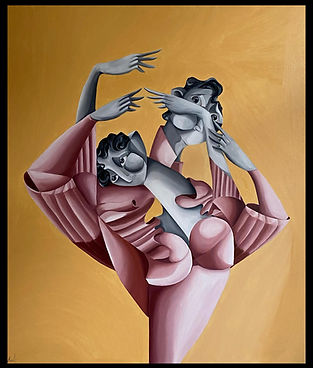
Artwork Title: DANCE
Year: 2020
Technique: Oil on canvas
Dimensions: 100 X 120 CM
Artist: Nil BÜYÜKBAYRAKTAR (birnil)
ESER ANALİZİ
1. Teknik Analiz
Eserde figürler çoğul yüzler, üst üste bindirilmiş kollar, akışkan tors yapıları ve ritmik pembe-boz tonlar aracılığıyla deforme edilerek sunulur. Nil Büyükbayraktar’ın karakteristik tekniği olan yumuşak geçişli modelleme, pürüzsüz yüzey, spiralize plastik yapı ve heykelsi hacimlendirme göze çarpar.
Arka planın düz ve mat sıcak sarı tonla tutulması, figürün hem ikonik hem de sahneleşmiş bir alan içerisinde titreşim kazanmasını sağlar.
Fırça darbeleri görünmezleşecek ölçüde rafine edilmiştir; bu yaklaşım, figürün materyal gerçekliğini geri çekip, ontolojik-spiral dönüşümü öne çıkarır. Bu durum, Merleau-Ponty’nin “beden her zaman görülen ile hissedilen arasında yaşayan bir arayüzdür” önermesiyle uyumludur (Merleau-Ponty, 1962).
2. Somatik Analiz
Eserdeki beden, anatomik doğruluğa değil, bedenin his-anılarını taşıyan bir somatik ize dayanır. Kolların ve yüzlerin çoğalması, tekil bir benlikten çok, bedensel deneyimin çoğul bilinç durumlarını temsil eder.
-
Eller yüzün etrafında sürekli yer değiştirerek korunma–açığa çıkma arasında devinen bir duygu sahnesi oluşturur.
-
Gövdedeki boşluk, iç oyuk ve kıvrımlar içsel duyumsama alanının dışavurumuna işaret eder.
-
Başların ikiye ayrılması, somatik hafızada çift yönlü zaman deneyiminin—hem olan hem olanaklı olanın—eşzamanlı varlığını gösterir (Sheets-Johnstone, 2011).
Bu yapı, bedeni edilgen bir nesne olmaktan çıkarıp akışkan bir öznel-mekân hâline getirir.
3. Topolojik Analiz
Nil Büyükbayraktar’ın figürleri genellikle topolojik deformasyon prensibine bağlı çalışır: beden parçaları klasik hacimsel anatomiden ziyade bükülmüş yüzeyler, katlanan vektörler, spiral kıvrımlar ve çoklu yüzey süreklilikleri üzerinden inşa edilir.
Bu eserde:
-
Figürün kol ve gövde hatları Moebius-vari bir geçişliliğe sahiptir; iç-dış, ön-arka ilişkileri sürekli yer değiştirir.
-
Yüzlerin üst üste binmesi çok katmanlı topolojik zaman yaratır; figür, tek bir anın değil, süreklilik gösteren bir hareket alanının temsilidir.
-
Göğüs, omuz ve yüz hatları arasında kesintisiz bir akış kuran bükümlü düzlemler, görünen form kadar formun kaçış çizgisini de görünür kılar (Deleuze & Guattari, 1987).
Bu topolojik yaklaşım, figürü “tek bir beden değil, değişen bir yüzey” hâline getirir.
4. Somatik Spiralizm Bağlamsal Çözümleme
Somatik Spiralizm’in temel kavramları—spiral ontoloji, beden temelli epistemoloji, somatik iz, çok-katmanlı spiral zaman, spiral akış dinamiği—bu eserde belirgin biçimde görünür.
a. Spiral Ontoloji
Figürün her parçası diğerine kıvrılarak bağlanır; kol, yüz, gövde ve jestler arasında kesintisiz spiral geçişler vardır. Bu, “varlık döner; dönüş bedenleşir” ifadesinin doğrudan görsel karşılığıdır
b. Beden Temelli Epistemoloji
Bilgi, figürün parçalanmış görüntüsünde değil, onun dönüş hareketinde ortaya çıkar. Beden, spiral akış içindeki bilgisel birim hâline gelir. Yüzlerin çoğalması, bilmenin duyu-alanları arasında dolaşımını işaret eder.
c. Somatik İz
Beden, yaşanmışlığın anatomik değil enerjetik bir kaydı gibi okunur. Gövde içindeki boşluk—tam da Somatik Spiralizm’deki “içten dışa doğru devinen iz”—bedenin geçici özdeşliğini açığa çıkarır.
d. Spiral Zaman
Bir yandan kolların havada “donmuş” hareketi vardır; öte yandan yüzlerin farklı yönlere bakışı aynı anda birden çok zaman düzlemini çağırır. Bu yapı, spiral zamanın katmanlı ve eşzamanlı işleyişini görselleştirir (Massumi, 2002).
e. Spiral Akış Dinamiği
Tüm kompozisyon bir dans figürünün içinde kıvrılarak kendi alanını yaratır. Bu dinamizm, Somatik Spiralizm’in “bedenin dönüşü resme dönüşür” önermesini tam olarak gerçekleştirir.
Kaynakça
Deleuze, G., & Guattari, F. (1987). A thousand plateaus: Capitalism and schizophrenia. University of Minnesota Press.
Massumi, B. (2002). Parables for the virtual: Movement, affect, sensation. Duke University Press.
Merleau-Ponty, M. (1962). Phenomenology of perception. Routledge & Kegan Paul.
Sheets-Johnstone, M. (2011). The primacy of movement (2nd ed.). John Benjamins.
ANALYSIS OF THE ARTWORK
1. Technical Analysis
In the work, the figures are presented deformed through multiple faces, overlapping arms, fluid torso structures, and rhythmic pink-gray tones. Nil Büyükbayraktar's characteristic technique of soft-transition modeling, smooth surfaces, spiraled plastic structures, and sculptural volumetric rendering is striking.
The use of a flat, matte warm yellow background allows the figure to gain a resonance within both an iconic and staged space.
The brushstrokes are refined to the point of being almost invisible; this approach withdraws the material reality of the figure and emphasizes its ontological-spiral transformation. This is consistent with Merleau-Ponty's proposition that "the body is always a living interface between the seen and the felt" (Merleau-Ponty, 1962).
2. Somatic Analysis
The body in the work is based not on anatomical accuracy, but on a somatic trace carrying the body's feelings and memories. The proliferation of arms and faces represents not a singular self, but rather multiple states of consciousness in bodily experience.
-
The hands constantly shift around the face, creating a scene of emotion that oscillates between protection and exposure.
-
The voids, hollows, and curves in the torso point to the outward expression of the inner field of sensation.
-
The splitting of the heads demonstrates the simultaneous presence of a dual experience of time in somatic memory—both what is and what is possible (Sheets-Johnstone, 2011).
This structure transforms the body from a passive object into a fluid subjective space.
3. Topological Analysis
Nil Büyükbayraktar's figures generally adhere to the principle of topological deformation: body parts are constructed not through classical volumetric anatomy, but through twisted surfaces, folded vectors, spiral curves, and multiple surface continuities.
In this work:
-
The arm and torso lines of the figure possess a Moebius-like transitionality; Inside-outside, front-back relationships are constantly shifting.
-
The overlapping of faces creates a multi-layered topological time; the figure represents not a single moment, but a continuous field of movement.
-
The twisted planes that create a seamless flow between the chest, shoulders, and facial features make visible not only the visible form but also the vanishing line of the form (Deleuze & Guattari, 1987).
This topological approach transforms the figure into “not a single body, but a changing surface.”
4. Somatic Spiralism Contextual Analysis
The fundamental concepts of Somatic Spiralism—spiral ontology, body-based epistemology, somatic trace, multi-layered spiral time, spiral flow dynamics—are clearly visible in this work.
a. Spiral Ontology
Each part of the figure is connected to the next by a twist; there are seamless spiral transitions between the arms, face, torso, and gestures. This is the direct visual equivalent of the expression “being rotates; rotation becomes embodied.”
b. Body-Based Epistemology
Knowledge emerges not in the fragmented image of the figure, but in its rotational movement. The body becomes an informational unit within a spiral flow. The multiplication of faces signifies the circulation of knowing between sensory fields.
c. Somatic Trace
The body is read as an energetic, not anatomical, record of lived experience. The emptiness within the body—precisely the “trace moving from inside to outside” in Somatic Spiralism—reveals the temporary identity of the body.
d. Spiral Time
On the one hand, there is the “frozen” movement of the arms in the air; on the other hand, the faces looking in different directions simultaneously evoke multiple planes of time. This structure visualizes the layered and simultaneous functioning of spiral time (Massumi, 2002).
e. Spiral Flow Dynamics
The entire composition creates its own space by twisting within a dance figure. This dynamism fully realizes the proposition of Somatic Spiralism that “the rotation of the body transforms into a picture.”
References
Deleuze, G., & Guattari, F. (1987). A thousand plates: Capitalism and schizophrenia. University of Minnesota Press.
Massumi, B. (2002). Parables for the virtual: Movement, affect, sensation. Duke University Press.
Merleau-Ponty, M. (1962). Phenomenology of perception. Routledge & Kegan Paul.
Sheets-Johnstone, M. (2011). The primacy of movement (2nd ed.). John Benjamins.